
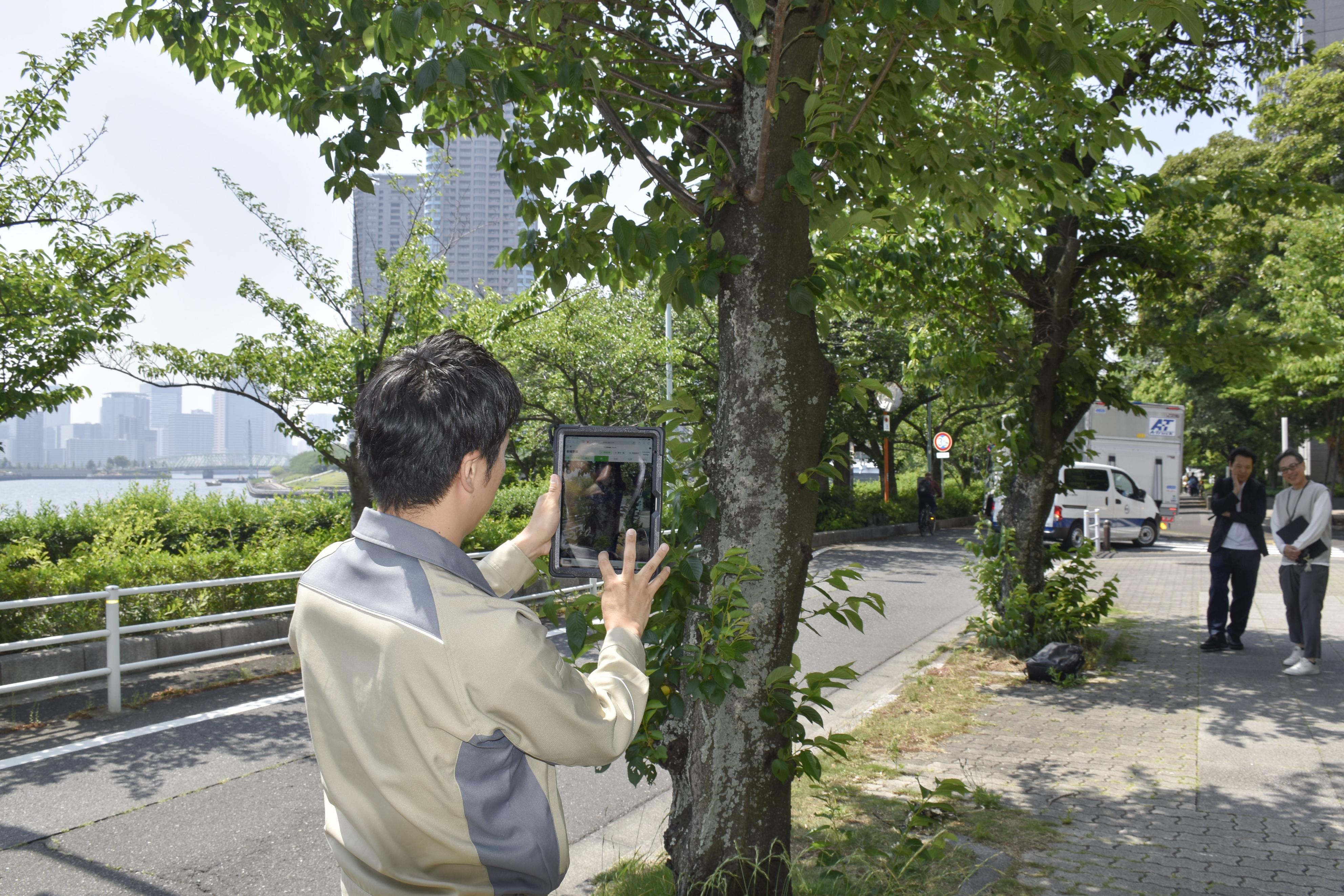
TOKYO – Scientists in Japan are working on AI-powered technologies designed to detect trees that could fall or drop limbs, as older street and park trees present an increasing threat to public safety.
An increasing number of municipal authorities are looking into implementing this technology due to a critical lack of tree experts and arborists, who examine trees and decide if they need to be cut down.
The current systems assess zelkova and cherry trees, with ginkgo and additional types planned for future inclusion.
From April 2021 to November 2024, a total of 1,732 incidents related to trees in parks and alongside roadways throughout Japan were documented, with 110 cases leading to injuries or fatalities, as stated by the Ministry of Land, Infrastructure, Transport and Tourism.
For instance, in September 2024, a man lost his life after a ginkgo tree branch snapped and landed on a path within a park area in Hino, Western Tokyo.
Trees found in parks and alongside streets are typically looked after by municipal authorities, yet they frequently receive insufficient care due to a lack of trained professionals.
A Tokyo-based information technology firm named Optim Corp. has partnered with Kyuden Droneservice Co., a drone service provider operating in Fukuoka, to create an artificial intelligence-driven system designed to identify deceased trees using unmanned aircraft.
An additional initiative is the tree risk evaluation AI system developed by Sumitomo Mitsui Construction Co., which examines images of dead or deteriorated sections of trees captured using a smartphone or tablet.
Tree AI analyzes images against tens of thousands of stored photos depicting trunks and limbs, and using insights from arborists, evaluates the likelihood of a tree collapsing on a four-tiered scale.
It delivers outcomes in just a few minutes and saves the data, such as the tree's position and analysis report, into a database.
"If a tree has an internal hollow space or fungi growing on its trunk, the chance of it collapsing rises. However, it can be challenging for non-experts to evaluate this situation," noted Hidemi Kataoka, a specialist in trees who participated in the project's creation.
Several local authorities, such as Kizugawa in Kyoto Prefecture, Miyakonojo in Miyazaki Prefecture, and the Tokyo Metropolitan Government, have conducted trials with this system. Kizugawa, responsible for approximately 20,000 trees, has faced challenges in carrying out routine checks due to limited personnel.
"AI makes it feasible to conduct effective and uniform inspections," stated an official from Kizugawa.
Approximately 20 regional authorities are evaluating the implementation of this system, as reported by Sumitomo Mitsui. The firm intends to introduce the service for commercial use in the fiscal year 2027.
"Many trees were planted during Japan's period of rapid economic expansion for reasons like capturing car exhaust fumes and are currently approaching the end of their life cycle," stated Sho Tago, leader of the company's green infrastructure division.
"We trust this service will aid in the effective and appropriate maintenance of trees despite having a small team," he stated.