
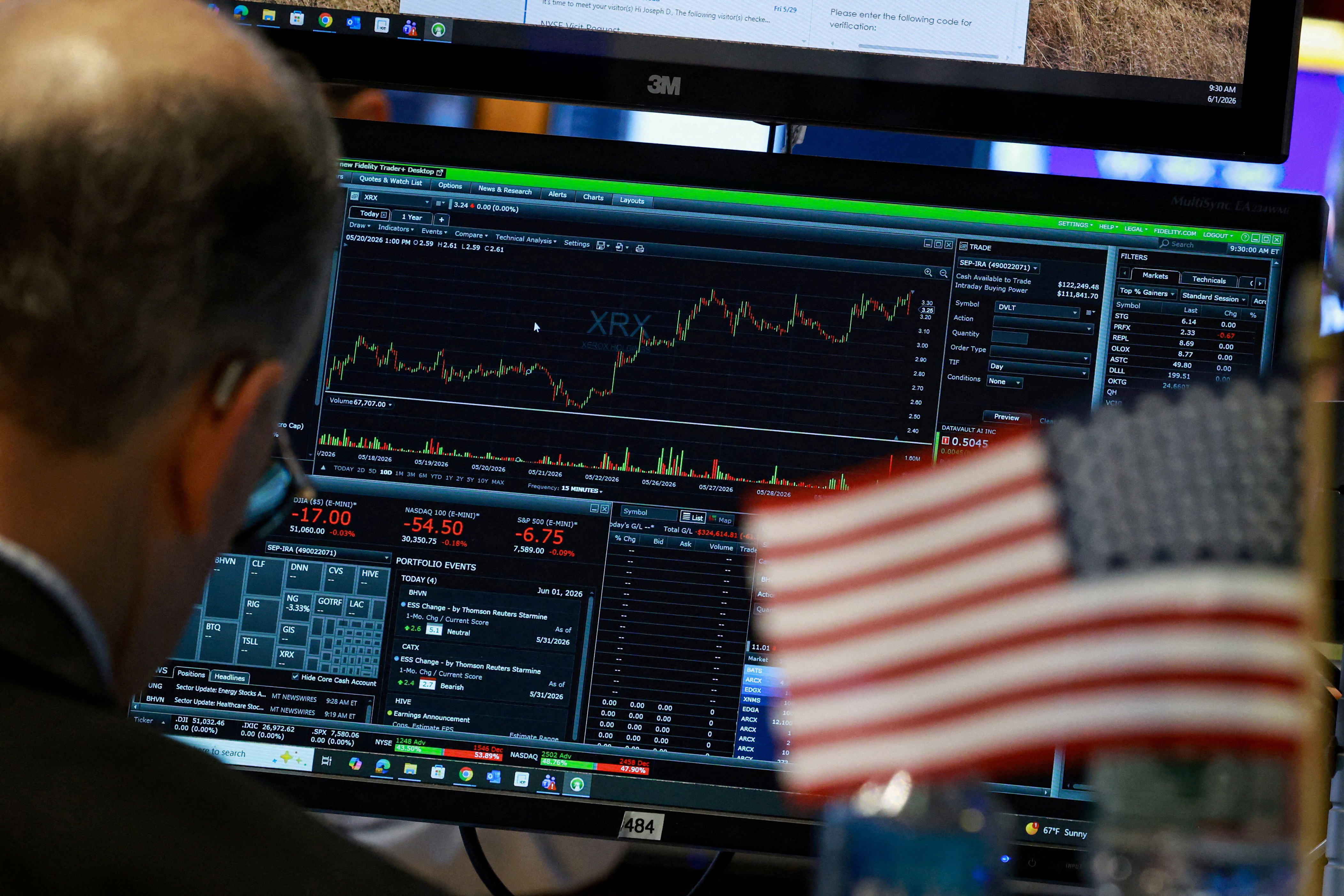
The U.S. New York stock exchanges ended with declines due to selling driven by profit-taking activities. U.S. Treasury rates increased broadly following comments from Federal Reserve Chairman Kevin Warsh indicating that inflation continues to be elevated.
On the 1st, the three main indexes at the New York Stock Exchange experienced minor declines. The Dow Jones Industrial Average decreased by 0.02%, the S&P 500 index, focused on large corporations, slipped by 0.2%, and the technology-oriented Nasdaq Composite Index saw a drop of 0.7%. Wall Street described the market activity for the day as “a pause.” The New York stock exchange recorded its strongest performance in six years during the second quarter due to growing enthusiasm around AI and related industries. Jeff Kilburg, Chief Executive Officer of U.S.-based financial advice company KKM Financial, stated to CNBC: "There continues to be a shift wherein capital that has taken gains from tech shares is moving towards Dow industrial stocks,” noting, "This represents a very positive development." Micron, which increased roughly 250% in the first half of this year, along with SanDisk, which jumped more than 850%, both dropped nearly 10.6%. Leading AI firms like NVIDIA and Broadcom also declined by 1.3% and 2.2% respectively.
Several major technology stocks increased. Meta, which revealed plans to enter a cloud business offering access to computational resources and artificial intelligence models, climbed 8.8% for the day.
All treasury yields increased. This was due to comments made by Chairman Warsh during a central bank conference in Sintra, Portugal, organized by the European Central Bank (ECB), in which he said, "Prices are excessively high." Investors expect the Federal Reserve to increase interest rates this year. The U.S. 2-year Treasury yield, tied to the key interest rate, climbed 0.03 percentage points to 4.17%, whereas the standard 10-year Treasury yield surged 0.05 percentage points to 4.48%.
In the meantime, global oil prices dropped to their minimum point in 4 months. Brent crude ended at $71.57 per barrel, declining by 1.9% compared to the last session, whereas U.S. West Texas Intermediate (WTI) crude reached $68.58 per barrel, reflecting a decrease of 1.3%. Brent crude has hit its lowest value since February 26, representing the smallest figure in 4 months.