
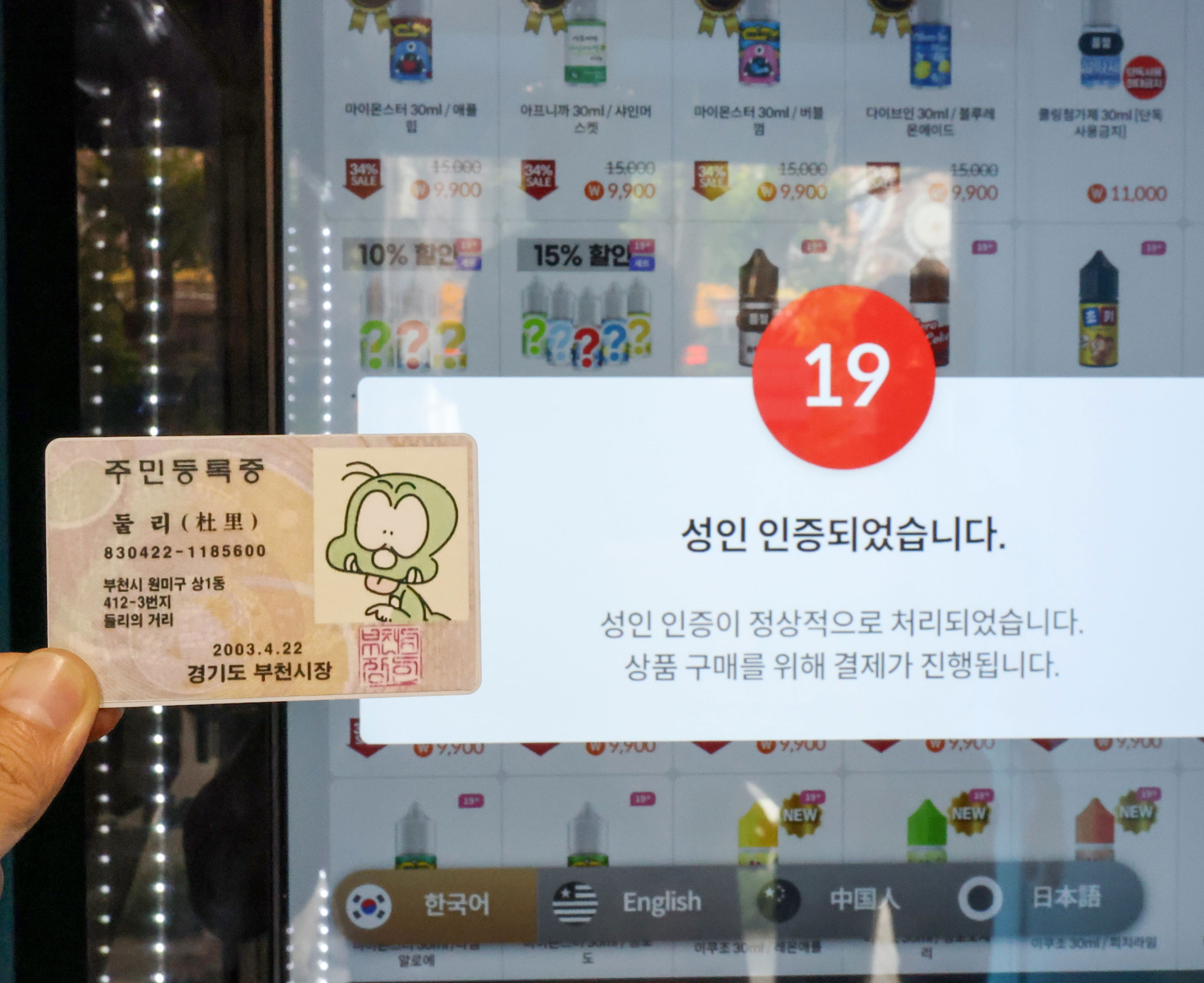
On the afternoon of the second day, a counterfeit resident identification card showcasing the cartoon figure "Ddol" was placed inside an electronic cigarette vending machine located at a subway station in Jongno District, Seoul. Following the activation of the adult confirmation button, the machine instantly declared, "The adult verification process has been successfully concluded." Once the transaction was finalized, the device issued a liquid-based electronic cigarette. The inscription on the machine stating, "Identity fraud leads to a permanent criminal record," appeared irrelevant under these circumstances. This fraudulent ID had been developed by the city of Seoul for testing purposes regarding the age verification mechanisms used by electronic cigarette dispensing units. It consisted of a plastic panel identical in dimensions to an official identity document, adorned with an image of Ddol. The name displayed read "Ddol," the birthday indicated "April 22, 1983," and the residence stated "Ddol Street, Wonmi-dong, Bucheon City." Although evidently fabricated, this ID managed to pass through the adult authentication system of the vending machine.
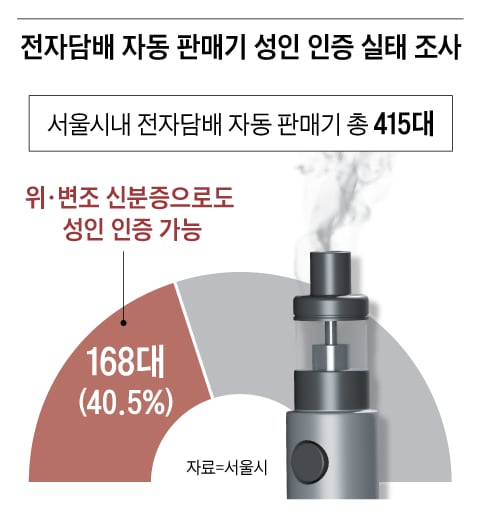
Between April and June, Seoul City conducted tests using five different counterfeit identification cards, such as the "Ddol ID," on 415 electronic cigarette dispensing machines throughout the city. Out of these, 168 devices (or 40.5%) were unable to identify the fake IDs. In 122 of those 168 cases, all five forged IDs were mistakenly accepted as real.
Under the National Health Promotion Act, e-cigarette vending machines must be equipped with adult verification systems; however, there are currently no specific guidelines defining the extent of this verification process. According to Choi Kyung-jin, head of the Korean Information Law Society, "Numerous businesses implement basic verification methods to reduce expenses." Vending machines using minimal verification techniques may simply check if the date of birth indicates an individual has reached adulthood. Certain models even just validate the format of the ID card, such as checking the dimensions and arrangement of characters and digits. A representative from the industry noted, "Vending machines capable of precisely verifying identity documents via the Ministry of the Interior and Safety's digital system typically come at an additional cost of around two million South Korean won." "Despite being discovered, unstaffed retail outlets often evade accountability by asserting, 'We weren't aware the person was under age,' which makes them hesitant to make investments."
The issue lies in the fact that these lenient systems are also used in unstaffed motels and automated alcohol shops. On the same day, officials from Seoul City inspected an unattended motel located in Gwangjin District, Seoul, using five counterfeit identification cards. The motel has rules against allowing underage individuals entry. When the "Ddol ID" was placed into the terminal, it showed, "Adult verification of the guest was successful." Each of the five forged IDs successfully cleared the motel's age check process.
Fake identification documents are readily accessible on social media sites such as X (previously known as Twitter). You may come across posts stating things like "We produce genuine ID cards for 100,000 South Korean won" or "We craft authentic ID cards featuring your preferred name, address, and photograph." Certain companies function under titles like "ID Retail Shop" or "ID Production Firm." These entities generate counterfeit IDs by imprinting characters, digits, and images onto vinyl materials affixed to plastic panels matching the dimensions of official residence certificates. Additionally, students sometimes utilize points cards to print out residential certificate templates, which can be conveniently located via online search engines.
A 17-year-old high school student named Choi Mo stated, "These days, there's no point in arguing with convenience store staff about cigarettes," and mentioned, "I purchase counterfeit identification cards and use electronic cigarettes." Teenagers also exchange details regarding vending machines that cannot recognize false ID documents.
As per the "Youth Health Behavior Survey" conducted by the Korean Disease Control and Prevention Agency, the proportion of teenagers using electronic cigarettes (2.4%) exceeded that of traditional cigarette smokers (2.2%) for the initial time last year.
Jo Young-chang, head of the Seoul Metropolitan Government's Citizen Health Department, stated, "We have asked the Ministry of Health and Welfare to enhance the process for penalizing entrepreneurs who do not adequately enforce adult identification protocols."