
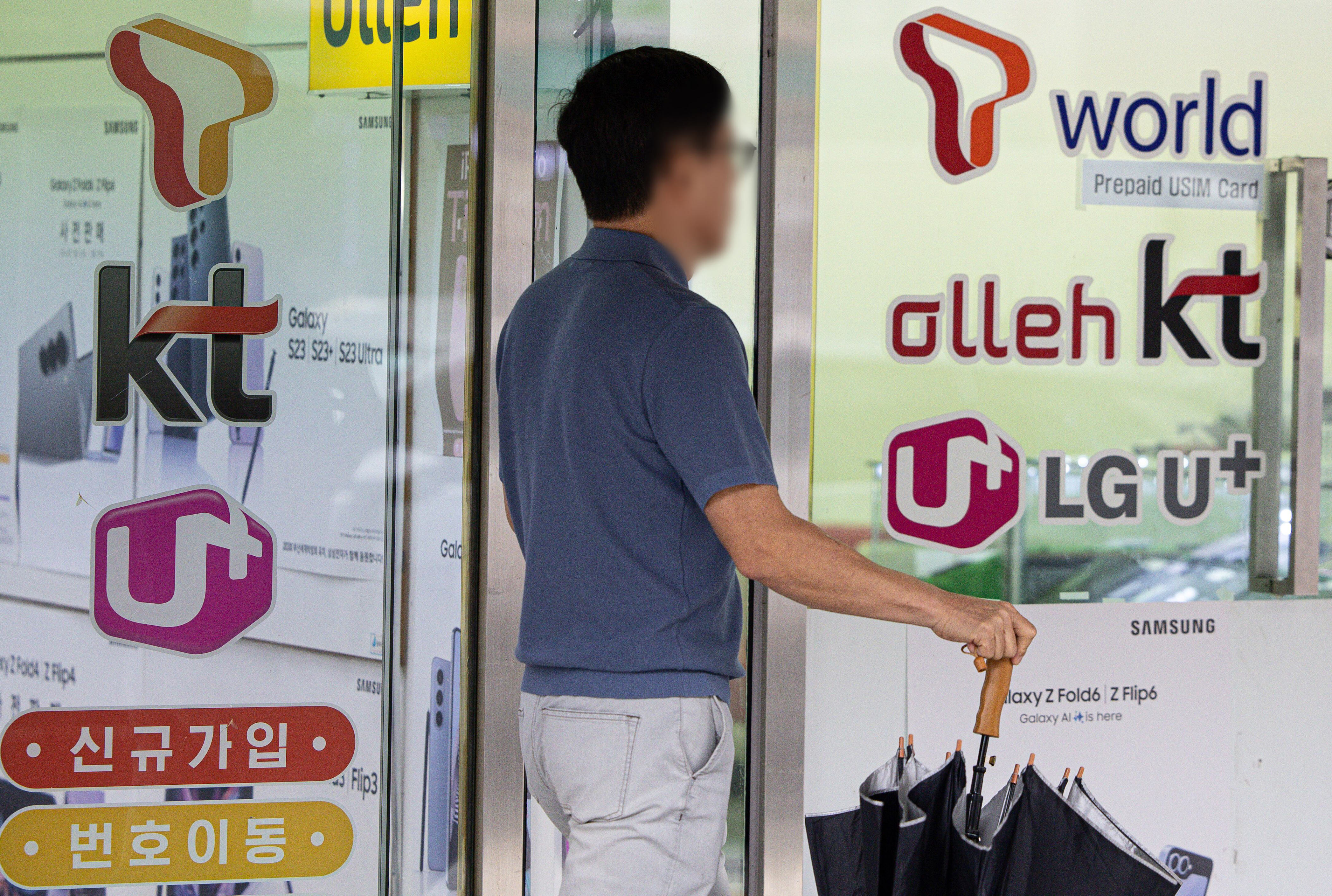
The leading three telecommunications firms in South Korea are gradually adjusting their package discount programs, which previously represented a sign of enduring customer commitment. After facing significant expenses last year due to cyberattacks, along with growing expenditures on artificial intelligence, experts believe these companies are now focusing more on financial gains by cutting back on promotional offers.
As reported by the telecommunications sector on July 2, KT will stop adding new mobile lines to its current "Customized Bundled" household plans from July 31 onward. The "Customized Bundled" offer provides a 10% reduction in basic charges per line for clients who combine fixed-line services—including high-speed broadband, traditional phone lines, and VoIP with mobile services. Combining up to five lines can result in an overall discount of up to 50%, serving as a key advantage for long-term subscribers.
KT stated, "We are stopping new line bundles for a product that saw its new sign-ups end in 2010 to simplify complicated pricing structures." Nevertheless, people within the industry believe this decision shows attempts to modify underperforming discounted programs for loyal clients.
◇ Telecom Three-way Competition Modifies Combined Offers
KT's choice indicates that all three major mobile service providers have reduced or removed combined discount offers. Previously, LG Uplus had stopped offering its "Easy Family Bundling" for specific new budget-friendly plans priced between 20,000 and 30,000 South Korean won as part of its unified pricing structure. Customers who subscribe to the "Data Plan 300MB (28,000 South Korean won)," "Data Plan 750MB (29,000 South Korean won)," and "Data Plan 1.5GB (33,000 South Korean won)" will no longer be eligible for family bundle discounts.
SK Telecom will cease accepting new sign-ups for its "T Family Discount" program from August 1 onward. This discount provides savings of up to 30% per month depending on the number of years family members have remained subscribers. The "T Family Discount" offered reductions based on the combined subscription duration of all family members under SK Telecom, with maximum benefits available after more than three decades of continuous usage. It served as one of the key advantages for customers who had used SK Telecom services for an extended period. Additionally, bundled offerings that combine mobile and internet plans are being phased out. In May, SK Broadband stated that new enrollments for both "T+ Internet (Individual)" and "T+ Internet (Family)" will conclude next month.
These modifications gained momentum following the implementation of bundled pricing options. Bundled plans aimed to make evaluations easier by combining 5G and LTE services based on data consumption and user behavior, responding to complaints about complicated billing systems. Nonetheless, detractors claim that telecommunications companies are leveraging this approach to cut back on promotional offers.
◇Reduced Expenses Despite Cybersecurity Expenses and Artificial Intelligence Spending
Telecom providers' efforts to cut back on discounts are linked to expenses related to compensating for cyberattacks and increased spending on artificial intelligence. Three firms reportedly allocated around 2 trillion South Korean won last year to handle cybersecurity breaches—that’s about 3.4% of their collective revenue and 46% of their operational profits. Expenditure on security has also risen significantly; overall investment in information security hit 367.6 billion South Korean won in 2025, up 22.1% compared to the prior year. Full-time security staff went from 293 in 2024 to 351 last year—a growth of 20%.
The ongoing competition for AI investments continues to increase expenses. These three firms are focusing on big language models (LLMs), artificial intelligence call centers (AICC), and speech-based fraud detection systems as key drivers of future expansion. Combined research and development spending during the last six years amounted to 4.4783 trillion South Korean won. Just last year, their investment set a new high at 800 billion South Korean won, with estimates indicating that the overall expenditure over seven years could surpass 5 trillion South Korean won by this year.
In intense competition for new subscribers, extended loyalty-based price reductions served as essential promotional strategies. Nevertheless, with evolving market dynamics, experts observe firms redirecting their advertising funds towards advancements in artificial intelligence and cloud technology. The decline of combined discount offers also indicates shifting consumer patterns, like the increasing number of individuals living alone who do not gain advantages from package deals. An insider within the sector mentioned, "Consumers who can’t utilize packaged services are seeking individual perks," further stating, "Shifting population trends are altering product configurations when contrasted with previous times."