
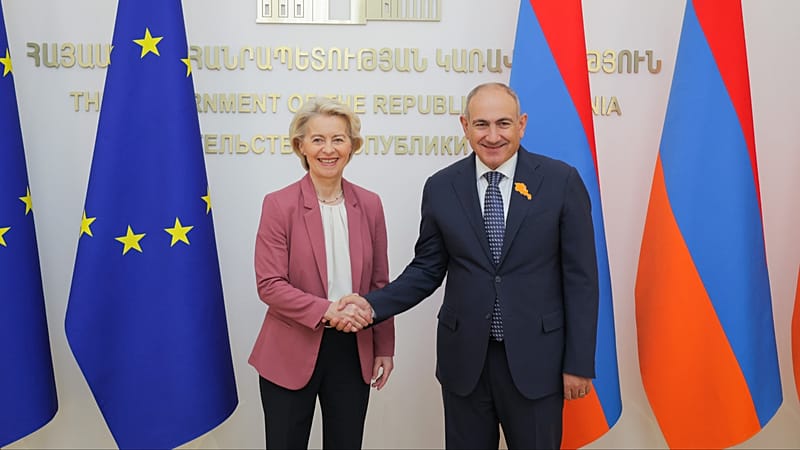
EU President Ursula von der Leyen expressed broad backing for Armenia during her trip to Yerevan on Thursday, which was part of a larger strategy-focused journey through the South Caucasus region. She introduced several uncommon financial initiatives aimed at assisting the nation in dealing with increasing Russian influence due to its hesitant shift towards Western alignment.
Praising Armenia's "more closely aligned relationship with Europe" and noting that "the citizens of Armenia opted for democracy (…), and decided to collaborate with the European Union," Von der Leyen introduced significant new funding initiatives, elimination of trade taxes on most Armenian goods exported to the EU, and promised assistance with simplifying visa procedures, as part of her reaction to what she described as Russia's "economic pressure" on the nation.
After visiting Azerbaijan on Wednesday, von der Leyen highlighted what she described as a "historic milestone" in the Armenian-Azerbaijani peace talks and the renewed drive for the EU's strategic involvement with the two ex-enemies, noting that "as Armenia moves nearer to the EU, the South Caucasus is becoming more unified."
With a strong political statement, the President of the Commission emphasized that by supporting Pashinyan in the latest elections, "the citizens of Armenia made their position evident. They opted for democracy. The principle of the rule of law."
They opted for reform and tranquility. They favored a transparent, hospitable, and representative community. And they decided to collaborate with the European Union," said von der Leyen. "And as one, we must now transform their hopes into achievements.
Von der Leyen also conveyed the EU's political backing for Armenia, saying, "I am aware that Armenia continues to experience considerable economic strain due to Russia, (...) however, be confident: when challenges arise for our allies, the EU responds more strongly... You can rely on us."
New trading policies aimed at circumventing Russian limitations
Armenia will now gain special advantages through a new EU mechanism, since it is not an EU candidate nation and lacks a traditional trade deal, enabling it to shift many of its goods away from Russian imports into European Union markets, free from import taxes.
Von der Leyen introduced a plan known as Autonomous Trade Measures, aiming to open up nearly 80% of Armenian products to the EU's market of 450 million people by eliminating import duties, thereby aiding the Armenian economy against Russia's increasing economic pressure through extensive trade limitations imposed on Armenia in recent months.
"This initiative will allow nearly 99% of Armenia's fresh produce, including fruits, vegetables, and plants, which were previously sent to Russia, to enter Europe, and it will grant access to the European Union’s single market for over 90% of your beverage and spirit exports," von der Leyen stated.
"In truth, during the last month, we've observed an increasing number of Armenian flowers reaching our market. I believe this represents a lovely emblem of a fresh phase in our economic collaboration. And this is just the start," remarked the President of the Commission.
Furthermore, von der Leyen mentioned that the EU will provide Armenia with an extra €18 million to aid commerce, marking the last portion of a larger €52 million initiative that the European Union established just before Armenia's important elections in June, which resulted in Armenian Prime Minister Nikol Pashinyan receiving a clear pro-Western endorsement.
Von der Leyen stated along with Pashinyan that Armenia continues to experience substantial economic pressure from Russia, which she described as nothing less than economic coercion.
During a press briefing, when questioned regarding the outlook for Armenia's ties with Russia, Pashinyan emphasized his measured stance, stating, "We have never aimed to and will not aim to provoke a disturbance in Armenian-Russian relations."
However, he clearly stated that "we act exclusively in the interest of our nation, we value the concerns of all our global allies, yet we will not prioritize the needs of any ally over those of Armenia."
Hundreds of millions committed to regional integration
The head of the European Union’s executive body reiterated the commitment of the 27-nation group, announced in Baku on Wednesday, to allocate €200 million toward a fresh EU connectivity program known as the Global Gateway initiative, aiming to "generate up to €2 billion for key transportation, energy, and digital projects throughout the South Caucasus," which will now include Armenia following its agreement with Azerbaijan.
Another important focus for the EU's involvement in the South Caucasus is connectivity, as the Middle Corridor has become a vital transportation route linking Asia and Europe, offering a robust Eurasian option amidst global supply chain issues in the Middle East.
The Middle Corridor, alternatively referred to as the Trans-Caspian International Transport Route (TITR), is an extensive transportation system comprising various roads, railways, and sea lanes that link China and Southeast Asia via Kazakhstan, Azerbaijan, and Georgia, continuing towards Turkey and Europe.
As the South Caucasus serves as a key component of the Middle Corridor, and since the EU aims to "build connections among people," von der Leyen additionally unveiled €20 million for a "programme promoting peace."
The money is intended to assist communities located near the border, boosting local economies and enhancing daily life, "so that peace becomes firmly established in the hearts and minds of this generation—and the one after," she stated.
With this statement, von der Leyen expressed backing for Pashinyan's declaration that Armenia has concluded the sorrowful period of conflict over Nagorno-Karabakh with Azerbaijan, enabling the two previous adversaries to build a harmonious future side by side.
Proposed relaxation of visa requirements and efforts towards energy variety underway
During his trip, Pashinyan stated that Armenia seeks to achieve visa-free travel with the European Union by 2029, contingent upon the nation's rate of reform implementation.
Von der Leyen replied by saying that the EU is carrying out an evaluation mission this fall and that Armenia is the sole nation currently undergoing an active visa facilitation process with the EU.
Since Armenia relies on Russian energy supplies, something Moscow has previously warned Yerevan about, the EU Commission President stated that European specialists will visit the South Caucasian nation to assist in expanding its energy sources, noting that the EU possesses "significant expertise" in this area, using Ukraine and Moldova as references.
Pashinyan stated that Armenia plans to construct electricity transmission lines together with Azerbaijan and Turkey to enhance the country's energy stability, alongside reviving transportation connections within the region.
Describing the Armenia-Azerbaijan peace initiative as "the most significant development in this area over recent decades," the EC president also commended Armenia for "its ongoing improvement of ties with Turkey."
"Such choices demanded political bravery and guidance. And I am aware of the significant benefits they will bring," Von der Leyen said to Pashinyan.
"Removing border restrictions will reshape Armenia's economic prospects and position Armenia as central to one of the globe's most crucial junctions. We will support you in making this dream come true," she stated.