
Editorial piece by Getachew Reda and Redwan Hussein
June 11, 2026 (ENA) — The Pretoria Accord provided comfort to an area in ruins. Individuals attempting to dismantle it should encounter strong global opposition.
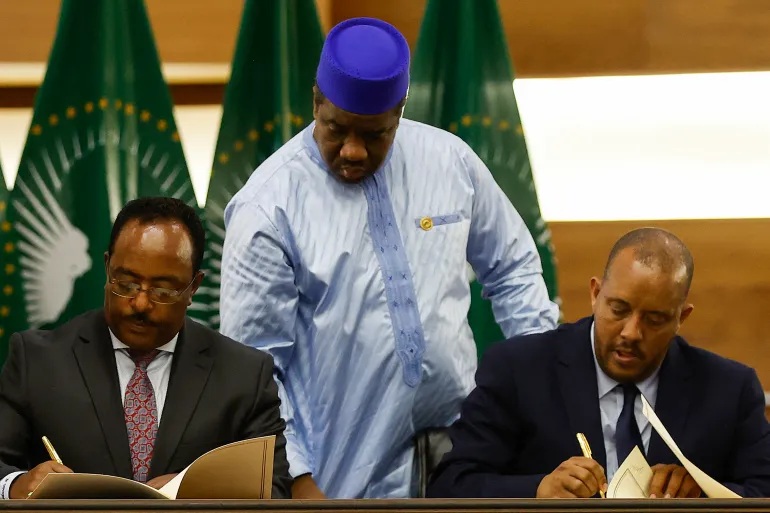
During October 2022, representatives of the Ethiopian central administration and the Tigray People’s Liberation Front (TPLF) convened in Pretoria, South Africa, with the aim of initiating reconciliation efforts.
Our gathering and discussions occurred during an intense conflict causing widespread destruction within our homeland. Under these conditions, our South African organizers had valid reasons for implementing certain measures to separate the two negotiating groups and maintain a physical distance between them. It seemed as though the protocols and security personnel provided by the host nation feared that representatives from both opposing sides might end up fighting each other in the center of the conference hall unless carefully guided away from one another. However, the hosts were eventually delighted to observe that maintaining politeness among all present in the room proved surprisingly easy.
Happy with the surprisingly friendly approach taken by leaders from both delegations, our hosts and facilitators permitted the negotiators to meet directly in a smaller space and under a more relaxed atmosphere, eliminating the necessity to communicate through English. As the mediators kept track of our developments and intervened when needed to overcome impasses, we conducted meetings over several days, often continuing past midnight. There were intense arguments and challenging conversations. At many points, the negotiations nearly collapsed. However, we continued forward, and thanks to the backing of experienced African elders who were guiding the discussions, we achieved more successes than failures.
During this time, even though we had originated from opposing factions during a brutal civil war, we shared a strong determination to achieve peace. Our aim was to bring an end to the violence. We sought to halt the killing. We were horrified by how the potential of a new generation was being lost on battlefields throughout northern Ethiopia. Additionally, we found consensus regarding the core values that should serve as the basis for any deal we reached. Right from the beginning, our conversations centered around essential principles that would guide our negotiations and their results. After agreeing upon a set of guiding principles to support the agreement, the next step involved developing and implementing those ideas effectively. This proved to be neither simple nor effortless. A fierce conflict continued while we engaged in discussions. At times, tensions escalated and the stress began affecting everyone involved. Nevertheless, we remained committed to finding mutual understanding and achieving lasting peace.
Despite the challenges, especially considering Ethiopia's recent past where agreements and concessions have been uncommon, we managed to achieve success. A Pact for Long-Term Peace based on an enduring ceasefire between the Government of the Federal Democratic Republic of Ethiopia and the Tigray People’s Liberation Front (TPLF) was finalized on November 3, 2022.
The implementation of the accord was received with approval and joy domestically. People across Ethiopia expressed relief and happiness as the conflict began to conclude. However, not every individual held these positive views. Within Ethiopia, radical groups affiliated with both the TPLF and the Amhara Fano militia reacted negatively to the deal.
Hardline members of the TPLF sought a brief truce that would enable them to rebuild their forces and keep up the conflict. Their intention was not for an enduring end to violence. Regardless of the price—particularly on the youth who were being used as expendable soldiers—they aimed to carry on the fight. They believed that a temporary pause in combat would provide them with time to replenish supplies, regain momentum, and secure a strategic advantage.
Some radical groups inside the Fano wished for the conflict to persist. Publicly, they argued that the federal administration was giving away too much and showing excessive tolerance toward the TPLF. However, later developments clearly showed that they had additional reasons for desiring ongoing hostilities. Similarly, if not more significantly, the Eritrean government opposed the Pretoria Accord. Eritrean leader Isaias Afwerki took things further by openly criticizing the deal as a scheme orchestrated by the CIA that failed to benefit the area.
For President Isayas, the internal strife in Ethiopia represented a favorable outcome. He desired for both factions to continue their conflicts until Ethiopia suffered greatly. He viewed peace and reconciliation in Ethiopia as dangerous. To achieve his aim of having a weakened, divided, and easily influenced Ethiopia, he had been supporting numerous rebel and militant organizations opposing the Ethiopian government for years. He didn’t wish for the Pretoria Agreement to bring about an end to the turmoil and pain in Ethiopia which brought him pleasure and solace. Therefore, he reached out to radical members of the TPLF and nurtured comparable figures inside the Fano. Eritrean agents facilitated an agreement among those dissatisfied with the Pretoria Agreement. Groups determined to maintain hostilities united under Eritrean guidance forming what they called Tsimdo.
Currently, this coalition, formed through secret and semi-secret gatherings in Asmara, Mekelle, and Sudan, stands ready to spark yet another wave of violence. Supported by Asmara, the radical faction of the TPLF has chosen to initiate an attack on the federal government in the near future. This action openly breaches the terms of the Pretoria Agreement, as the remaining group of the TPLF has dissolved the local provisional administration and established an unlawful one instead. They have kept expanding, educating, and equipping a large military force under the explicit backing of the Eritrean authorities. Furthermore, they have removed and discarded anyone inside their organization who supported peace and compliance with the Pretoria Agreement.
The inhabitants of the Tigray region have firmly opposed the conflict strategy and the dangerous aggression associated with the splinter faction of the TPLF. However, adopting some tactics similar to those used by Eritrea, the TPLF is currently implementing compulsory recruitment and attempting to transform Tigray into yet another "utopia of resistance." The breakaway group within the TPLF has publicly disregarded the Pretoria Accord and is preparing for direct confrontation with the central authority.
It is crucial for all individuals who possess any power or sway over the TPLF and their supporters in Asmara to apply full force to prevent a return to warfare. Resuming fighting would pose significant risks and could lead to severe repercussions across the region. The TPLF must not be permitted to turn back to violence and risk the lives of numerous young people. The global community needs to send an unequivocal, firm, and unyielding statement that the actions being taken by the TPLF and those backing them in Asmara—aimed at violently dismantling the Pretoria Accord in a way that may be permanent—are completely intolerable.
The Pretoria Accord is far from flawless, with its execution being an ongoing process that fell short in many aspects. However, it was an arrangement that brought about a cessation of hostilities and helped restore some level of stability to an area devastated by conflict. We must prevent the misguided strategies of individuals who have grown completely indifferent to the loss of life and hardship endured by an entire generation from dragging us back into the horrors of war.
Advisor to the Minister of East African Affairs within Ethiopia's federal administration
Getachew Reda serves as Ethiopia's Minister Advisor for East African Affairs, previously led the Transitional Regional Administration of Tigray, and represented the TPLF in signing the 2022 Pretoria peace deal.
Head of Ethiopia's National Intelligence and Security Service who acted as the central representative for the federal government during the 2022 Pretoria peace negotiations
Redwan Hussein serves as the head of Ethiopia's National Intelligence and Security Service and acted as the official envoy from the Ethiopian government when signing the 2022 Pretoria peace deal.
Source: Al Jazeera
 Supplied by SyndiGate Media Inc. (
 Syndigate.info
).
Syndigate.info
).