
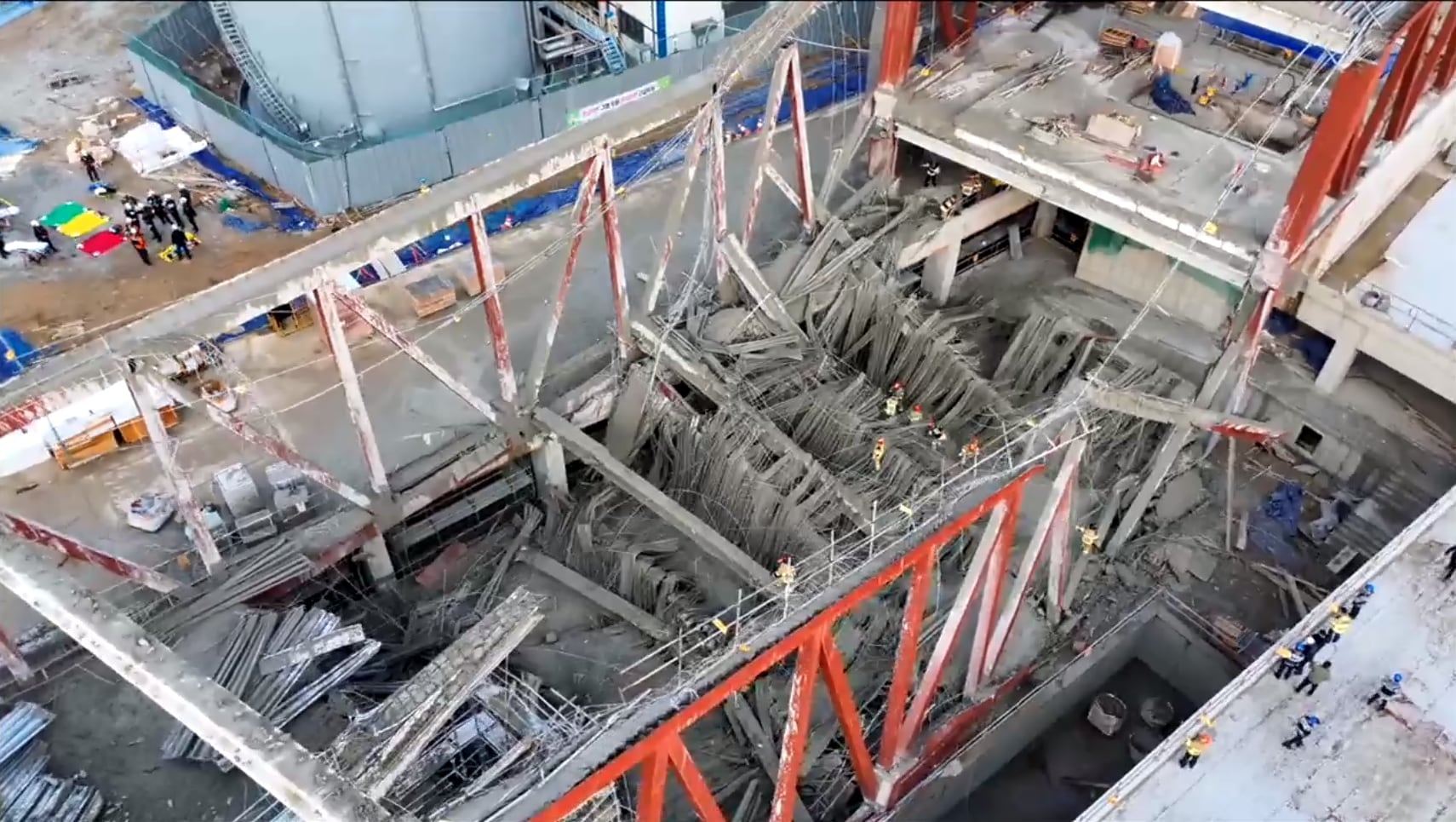
Regarding the collapse incident at the Gwangju Representative Library, which led to four fatalities, the site supervisor from the construction firm and the head of the sub-contractor have been taken into custody.
On the 12th, the Gwangju District Court issued provisional arrest warrants for four people, including the site supervisor from the construction firm responsible for the Gwangju Representative Library, the chief executive officer and staff member of the sub-contractor, and the leader of the inspection group, all facing allegations like workplace negligence leading to fatalities and breaches of the Occupational Safety and Health Regulations.
Approximately 1:58 p.m. on December 11 of last year, four employees lost their lives when they were trapped in a collapse at the construction site of the Representative Library, which is situated on the previous location of the Sangmu Incineration Plant in Cheopyeong-dong, Seogu, Gwangju Metropolitan City. Shortly following the incident, it became clear that the connections between the steel column and beam sections had been cleanly cut, prompting authorities to examine if the construction work met proper standards.
Law enforcement requested pre-bench warrants targeting 11 people considered accountable. The court approved bench warrants for just four individuals, among them Mr. A, who was seen as having major liability, whereas requests were denied for seven others, such as executives from the construction firm and workers at the site. Dealing with those found responsible took place roughly half a year following the incident.
As per studies conducted by specialized organizations, including the National Disaster Management Research Institute affiliated with the Ministry of the Interior and Safety, the primary reasons for this incident were identified as substandard foundational work, such as improper welding at the connections of the steel framework, the use of inadequately trained welders, and lapses in oversight.
The inquiry uncovered that the construction of the steel structure, which was a key phase, took place via unlawful subcontracts. Initially, there had been plans to produce a 48-meter-long truss (a steel frame) as a single unit in a factory and then erect it at the location. Nevertheless, it came to light that this approach was altered, with two separate 24-meter sections being transported to the site and joined together side by side through welding.
Certain procedures were carried out via a layered sub-contracting system. It was also verified that unlicensed building firms took part in the construction work without formal agreements, utilizing the names of other companies.
The research institution found that the standard of building work declined when complex jobs were continuously outsourced. Throughout the inquiry, a welder reportedly said, "Building authorities pressured us to speed up our welding."