
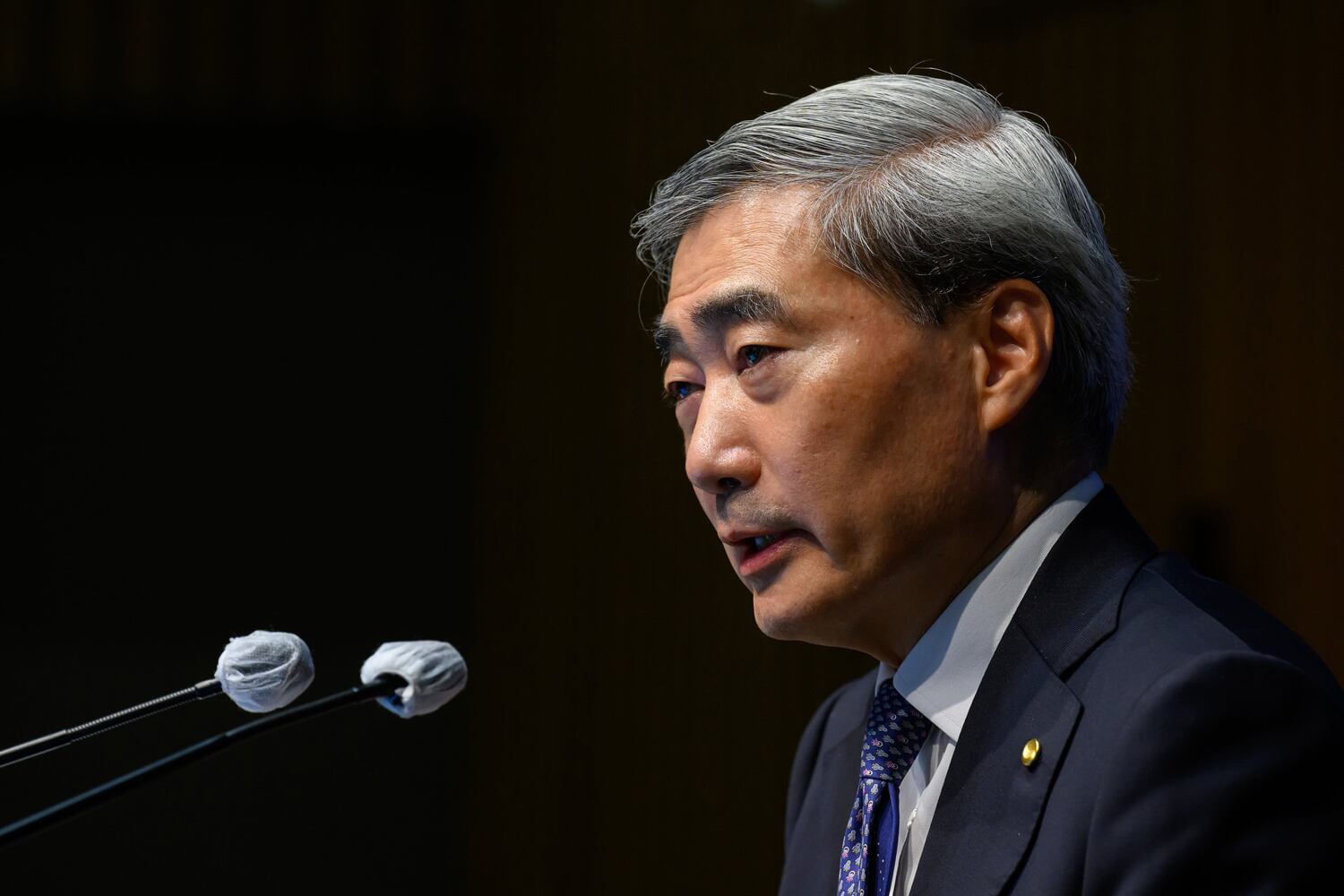
South Korean Central Bank Governor Shin Hyun-song remarked, "There is a need to increase interest rates immediately, focusing on maintaining stable prices." This statement is seen by the financial markets as the most significant indication of monetary tightening since Governor Shin assumed his role in April. An interest rate rise during next month's Monetary Policy Committee session appears highly likely, with experts also considering the chance of further hikes throughout the year.
During his address marking the 76th anniversary of the Bank of Korea on the 12th, Governor Shin stated, "Monetary policy frequently encounters compromises among different factors, yet these tensions are minimal right now," noting, "Economic indicators related to growth, inflation, and financial security indicate a fairly straightforward path from a monetary policy standpoint." Previously, following the decision to keep interest rates unchanged during the previous month's Monetary Policy Board session on the 28th, he commented, "I think we could have presented a compelling argument for increasing rates this time."
Governor Shin identified that South Korea's economy is experiencing more robust growth than anticipated, thanks to a surge in semiconductors boosted by the rise of artificial intelligence (AI). He pointed out that the real economic growth for the first quarter hit 1.8% compared to the previous period, far surpassing early projections, with the nominal growth rate registering an "unparalleled increase" of 10.5%.
Nevertheless, he voiced worries regarding increasing price volatility. "The Consumer Price Index (CPI) climbed into the 3% bracket in May," he mentioned. "Even core inflation, which had remained steady, moved up to the middle of the 2% range because of higher costs in certain personal service sectors." He further noted, "Anticipated future inflation levels are expected to stay beyond the desired threshold for an extended time. Additionally, there are deeper anxieties that intensified household inflation forecasts and the possibility of companies increasing their pricing may add more upward momentum to inflation."
He additionally cautioned regarding excessive heat in financial markets. "In the real estate market of the capital area, both sales and jeonse prices keep increasing rapidly, with renewed expectations for additional rises," he stated. "With stock prices rising quickly, 'investment strategies fueled by debt' using borrowed money have also seen a significant increase. Overleveraging affects personal profits and losses when prices decline and can heighten market instability."
Governor Shin referenced the strain on families with limited income as justification for increasing rates. "As inflation disproportionately affects lower-income individuals, taking early steps to keep prices stable is also a method to avoid further hardship," he said.
The marketplace views these statements as an implicit indication of an upcoming interest rate increase. As worries about inflation intensify because of higher energy costs originating from the Middle East, leading central banks are returning to tighter policies. At its monetary policy gathering held on the 11th, the European Central Bank (ECB) increased all three primary policy rates by 0.25 percentage points each, raising the deposit rate from 2.00% to 2.25%, the main refinancing rate to 2.40%, and the marginal lending rate to 2.65%. This represents the ECB's initial rate adjustment in over two years and nine months, dating back to September 2023, and it is the first such move among major developed economies' central banks since the start of the conflict in Iran in February.
The result of the U.S. Federal Open Market Committee (FOMC) gathering held on the 16th through the 17th has attracted significant interest. Although markets expect an unchanged interest rate, some analysts believe that if the Federal Reserve delivers a more aggressive than anticipated cautious message, it might strengthen the tight monetary policies adopted by leading central banks. On the 11th, the U.S. Producer Price Index (PPI) for May showed a 6.5% annual increase — the highest point in three years and six months, dating back to November 2022 when it was recorded at 7.4%. Meanwhile, the U.S. Consumer Price Index (CPI) for May climbed 4.2% compared to the previous year, expanding from 3.8% in April.
During his memorial address, Governor Shin highlighted linking higher company earnings, especially within the semiconductor sector, with upcoming investments. "Although today’s circumstances reflect our collective hard work, it is equally vital to acknowledge that much of this success comes from positive outside factors," he stated. "It is essential to increase investments aimed at boosting long-term growth prospects, leveraging improved government budgets and stronger business finances. Ongoing initiatives to reduce divisions among areas, age groups, and societal classes should not be neglected."
Sources within the industry view this in relation to ongoing debates about performance-linked incentives at major firms like SK Hynix and Samsung Electronics. The statement is understood as a call for businesses to direct higher earnings stemming from the artificial intelligence chip surge not only toward immediate benefits but also towards research and development and infrastructure upgrades to ensure long-term competitive advantage.