

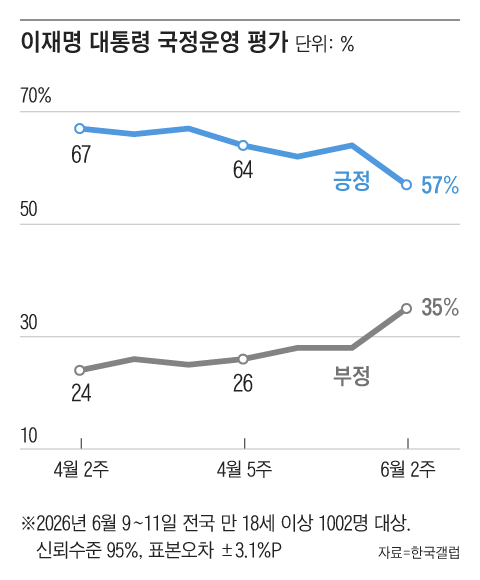
A public opinion poll published on the 12th revealed that President Lee Jae Myung's approval score regarding national matters fell by seven percentage points to 57%, according to a survey conducted three weeks earlier. This decrease was linked to the widespread issues with insufficient ballots during the June 3 local elections.
A poll carried out by the South Korean research company Korean Gallup between June 9 and 11, involving 1,002 participants across the country, found that 57% believed President Lee was "performing well," whereas 35% thought he was "performing badly." These numbers represented a drop of seven points and an rise of one point, respectively, when contrasted with the earlier survey. Another eight percent chose not to express their views.
The primary cause behind unfavorable assessments of President Lee's leadership was "ineffective and unjust electoral administration, problems with the National Election Commission" (16%), succeeded by concerns over "the economy, living standards, and elevated exchange rates" (14%), "housing policies" (9%), and "ethical controversies, evasion of legal proceedings" (8%).
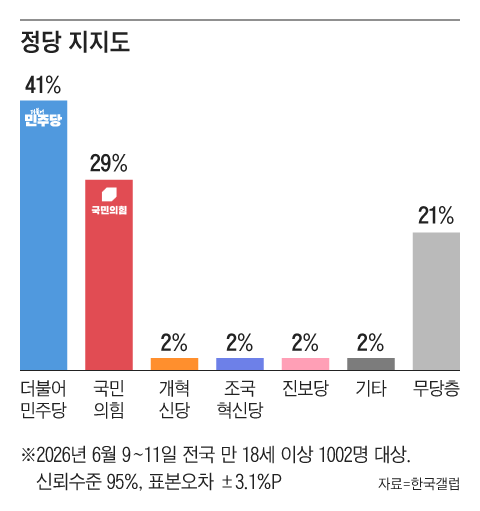
In terms of party backing levels, the Democratic Party of Korea secured 41%, compared to 29% for the People Power Party. The Democratic Party saw a decline of 4 percentage points from the earlier poll, while the People Power Party increased by 7 percentage points, reaching its peak support since the start of the Lee Jae Myung government in June.
In addition, the same poll showed that four in ten participants backed demands for a complete rerun because of the voting material shortages observed in the June 3 municipal elections. Significantly, 60% of individuals aged between 20 and 30 endorsed the call for a new election.
When questioned regarding their position on the re-election initiative, 44% expressed agreement, 48% voiced opposition, and 8% chose not to share their views. Within those aged in their 20s and 30s, 67% and 62% respectively backed the re-election.
67% of participants considered the lack of ballots as a problem related to "ineffective election administration and violation of voting rights," whereas 25% regarded it as proof of "unlawful electoral intervention or efforts toward unjust elections."
The study was carried out through telephone conversations with randomly chosen mobile virtual numbers. The margin of error stands at ±3.1 percentage points with 95% confidence. For more information, check the National Election Opinion Survey Deliberation Commission's official site.