
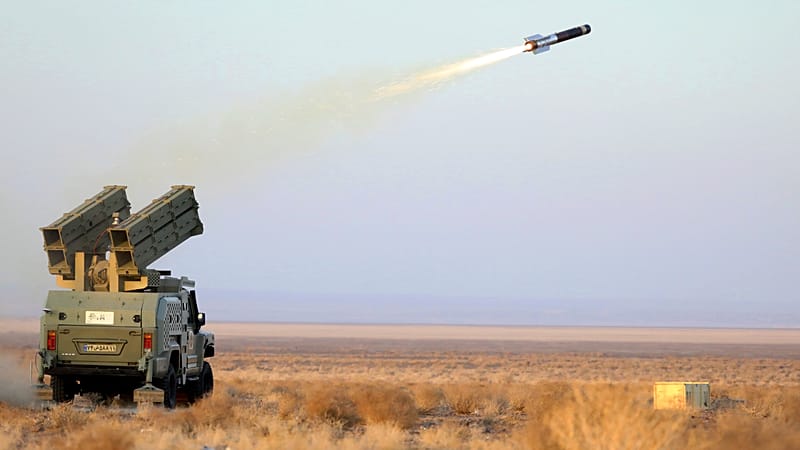
On Wednesday morning, Iran carried out a missile strike targeting Jordan, Bahrain, and Kuwait, marking another round of retaliatory attacks against the United States following the incident involving a U.S. helicopter shot down near the Strait of Hormuz.
In a declaration, the Islamic Revolutionary Guard Corps stated that Iranian military units launched "long-range missiles," asserting that they "hit and eliminated four significant objectives" in Jordan, such as F-35 aircraft facilities at an airfield and the U.S. headquarters located in Al-Azraq, according to the official IRNA news outlet.
On Wednesday, Jordan reported that it intercepted inbound missiles targeting its significant historic city of Azraq, located approximately 100 kilometers from the capital, Amman.
A significant Jordanian airfield named Muwaffaq Salti is situated nearby, serving as home to the Jordanian Air Force's 1st, 2nd, and 6th Fighter Squadrons.
"Five missiles fired from Iran toward Azraq were intercepted and destroyed. The interception caused debris to fall, although there were no injuries or property damage," stated the Jordanian Armed Forces in a press release.
The United States and various NATO partners have previously utilized the airbase, including for conducting attacks against the self-proclaimed Islamic State organization throughout the conflict in Syria.
The Jordanian government-controlled Petra news agency reported the military's statement, noting that there were no casualties from the incident and that bomb technicians had inspected the remnants of the intercepted objects.
The Kuwaiti armed forces stated their air defense systems were confronting "hostile airborne objects," not specifying the attacker right away, despite Iran having conducted lethal strikes against the nation lately.
The leadership of the Bahraini Armed Forces stated that they effectively stopped an unspecified quantity of missiles, noting that Tehran maintained what it described as a "deliberate aggressive strategy," characterized by "illegal strikes involving missiles and unmanned aerial vehicles aimed at citizens within the country."
U.S. attacks triggered by an Apache helicopter incident
The events followed the U.S. Central Command (CENTCOM) stating that it had "conducted defensive attacks against Iran."
According to the statement, CENTCOM troops used precise weapons launched by U.S. Air Force and Navy fighter planes to attack Iranian air defense systems, ground command centers, and monitoring radar facilities close to the Strait of Hormuz.
"the action constituted an appropriate reaction to the latest assaults against american military personnel and global cargo vessels passing through the area," centcom stated.
State-controlled Iranian media previously mentioned multiple sets of blasts occurring close to Iran's southern coastline, near the Strait of Hormuz. Tehran warned that it would take action in response.
Iranian troops "will not let any attack or threat go unchallenged," said Iranian Foreign Minister Abbas Araghchi on X. "If you wish to remain secure, stay away from our area."
A U.S. military source, speaking under confidentiality for an active inquiry, reported that the U.S. Army's AH-64 Apache combat helicopter crashed close to the Strait of Hormuz following a collision with an Iranian unmanned aerial vehicle.
It was uncertain if the impact was deliberate, with officials stating the accident was still being looked into.
Earlier today, U.S. President Donald Trump stated via a social media update that Iran had destroyed the plane as it was conducting surveillance near the strait, and he asserted that the United States "must inevitably react" to this incident.
The shooting down of an Apache attack helicopter and U.S. military attacks added more tension to a two-month cease-fire, just one day after Iran and Israel engaged in gunfire for the first time since the delicate agreement was put in place.
Prior to blaming Iran for shooting down the American helicopter, Trump had shown increased hope regarding talks with Teheran, without going into details.