
The United Nations has urgently called for restraint and adherence to the established truce following Israel's escalation of military operations in Lebanon, a development threatening to derail delicate U.S.-Iran diplomatic efforts.
Our primary concern is the increase in military actions throughout southern Lebanon and surrounding areas," stated Stephane Dujarric, spokesperson for United Nations Secretary-General Antonio Guterres. "We call upon every party involved to uphold the ceasefire and prevent additional tensions from arising.
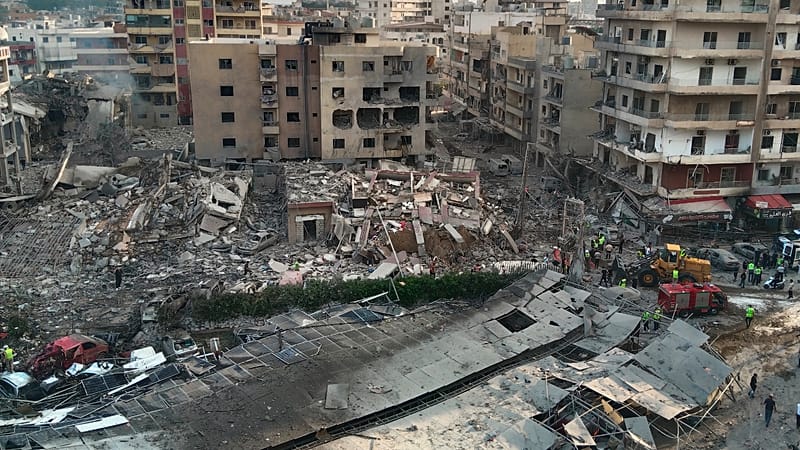
The United Nations' appeal occurred while the Israeli government carried out airstrikes on the southern neighborhoods of Beirut on Monday, following a day when its land troops advanced to their deepest position in Lebanon in 26 years, alongside Hezbollah launching missiles toward northern Israel, including areas near the coastal town of Haifa.
A reliable source connected with Hezbollah told AFP news agency that the Iran-supported organization will continue striking northern Israel. The source repeated: "Hezbollah has not promised to cease hostilities," requested confidentiality, and stated, "What reason do we have to halt operations that harm Israel when it keeps bombing Lebanon?"
Israel also warned of bombing Beirut's southern neighborhoods if the fighters persisted with their assaults, leading to increased tensions.
On Monday morning, Israeli Defense Minister Israel Katz stated, "If there isn't peace in the north, there won't be peace in Beirut," whereas a high-ranking U.S. representative informed AFP on Sunday that Washington had put forward "a specific plan: Hezbollah needs to cease all attacks against Israel. As compensation, Israel would avoid increasing tensions in Beirut."
Iran gets ready to open additional frontlines
On the same day, Iran's Revolutionary Guard warned of opening "new frontlines" and maintaining closure of the Strait of Hormuz due to Israel's military actions in Lebanon, according to official news outlets.
Iran views crossing the red lines in Lebanon and Gaza as equivalent to entering into an open conflict," stated television news reports citing the Intelligence Organization of the Revolutionary Guard. "As a result, it is committed to conducting defensive measures through impactful actions and establishing additional frontlines, along with maintaining the balance in the Strait of Hormuz.
During Monday night, Mohsen Rezaee, an army consultant for Iran's top leader Ayatollah Mojtaba Khamenei, shared on X: "The rising tension in Lebanon won't be accepted," and stated that "Iran's military forces have their limits when it comes to tolerance."
Earlier, the Tasnim news outlet stated that Iran and its partners planned to "open additional frontlines, such as the Bab al-Mandab Strait," near the entry point of the Red Sea, in reaction to Israeli military operations.
The Houthis, Iran's ally in Yemen, have earlier targeted vessels in the strait and surrounding areas, compelling ships to make extended routes around Africa instead of passing through the Red Sea and Suez Canal.
The Red Sea is also where the Saudi port of Yanbu is located, from which Riyadh has shipped millions of barrels of oil, avoiding Iran's complete shutdown of the Strait of Hormuz and the Gulf.
A hospital in Lebanon comes under attack
The situation keeps worsening for Lebanon, with an Israeli air strike causing significant damage to the Jabal Amel Hospital in the coastal city of Tyre on Monday afternoon, breaking windows and destroying building exteriors. Video shared by the Lebanese Health Ministry depicted frightened women and children within the wreckage-filled hospital.
An assault comes after a series of night-time strikes throughout southern Lebanon that resulted in six fatalities, as reported by the government-backed National News Agency.
In addition, Hezbollah launched rocket and missile strikes against northern Israel on Sunday. On Monday morning, the group officially announced that it had targeted Israeli forces in Zawtar al-Sharqieh, located north of the Litani River, and hit what it claimed were Israeli military facilities in Tiberius, several dozen miles south of the border.
Each side accuses the other of causing the intensification
Hizbullah committed to stopping attacks against Israel upon signing the truce in mid-April, yet the armed organization renewed hostilities following Israeli bombings in Lebanon, which Israel described as acts of self-defense.
The intensification of conflict between Israel and Hezbollah has emerged as a significant challenge for U.S.-Iran negotiations aimed at prolonging the truce in the ongoing Iranian conflict, with Tehran insisting that Lebanon be part of any such arrangement.