
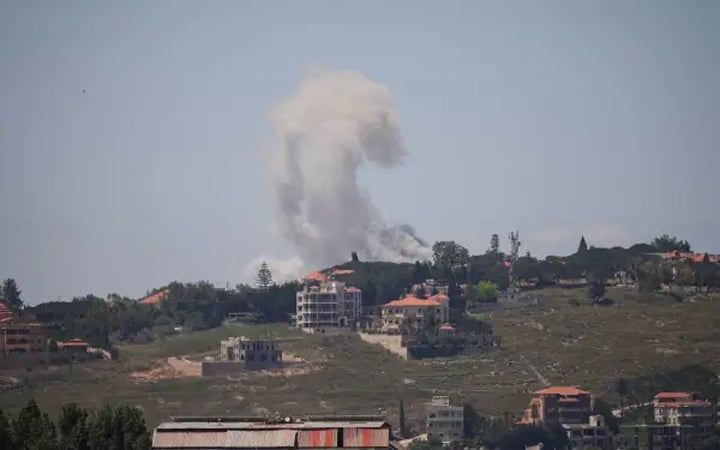
June 7, Pakistan - According to the U.S. military, American forces targeted Iranian coastal radar installations on Saturday following the destruction of drones sent by Iran towards the Strait of Hormuz, marking another intensification that adds complexity to ongoing attempts to conclude the conflict between the two nations.
A U.S. official informed Reuters that the American forces thought the four Iranian drones were aiming at local sea trade. The U.S. Central Command stated on X that the United States subsequently attacked Iran's monitoring locations in Gorgon and Qeshm Island, which are situated near the Strait of Hormuz.
The Iranian Ministry of Foreign Affairs stated that the U.S. move violated the cease-fire agreement reached on April 8, noting that these recurring breaches indicated that Washington has no desire to ease hostilities. It cautioned that the United States would be held accountable for the outcomes of its "unlawful activities."
The Iranian Revolutionary Guard claimed they targeted American facilities in Kuwait and Bahrain as an act of revenge for U.S. attacks, and also opened fire on four oil tankers attempting to pass through the Strait without their approval.
On Saturday, Kuwait's military stated that it intercepted seven ballistic missiles which flew over populated neighborhoods, causing property damage without any injuries. Meanwhile, in Bahrain, alarms rang out, prompting locals to take cover.
Kuwait and Bahrain expressed condemnation of the attacks. Later, Iran claimed it struck U.S. bases in both nations using ballistic missiles, although the U.S. military stated that six missiles were intercepted and a seventh failed to reach its destination.
The United States and Iran have been involved in mostly back-and-forth discussions aimed at reaching a temporary agreement to end the conflict that has lasted three months, with matters such as Iran's nuclear program set for future talks.
However, an agreement has not been reached because the two parties have occasionally engaged in conflicts.
Iran seeks access to billions of dollars in oil earnings, exemptions from restrictions on oil exports, the removal of a U.S. embargo on its maritime routes, and influence over the Strait of Hormuz. Iran has essentially restricted this passage, which previously saw approximately 20% of worldwide oil shipments during the conflict.
According to Iranian state news outlets, Mohsin Naqvi, who serves as Pakistan's home secretary and is involved in facilitating peace efforts, landed in Tehran on Saturday to engage in discussions with senior Iranian authorities such as Foreign Minister Abbas Araqchi.
A Pakistani official stated that Naqvi would deliver a communication from Pakistan to Iran's Supreme Leader, Ayatollah Mojtaba Khamenei.
U.S. President Donald Trump is encountering increasing internal political challenges as higher gasoline costs push him to conclude the unliked conflict. In statements made to NBC, he mentioned that although many of Iran's drones and missile production sites had been obliterated, the Iranian forces still retained access to roughly one-fifth of their missile inventory.
"They possess certain missiles and also some drones. I'd estimate that around 21-22% of their missile arsenal is operational. Although this is still a significant number of missiles, it isn’t as much as it was during our initial attacks," said Trump in an interview with NBC News’ “Meet the Press” show, as reported by the network in excerpts released on Friday.