
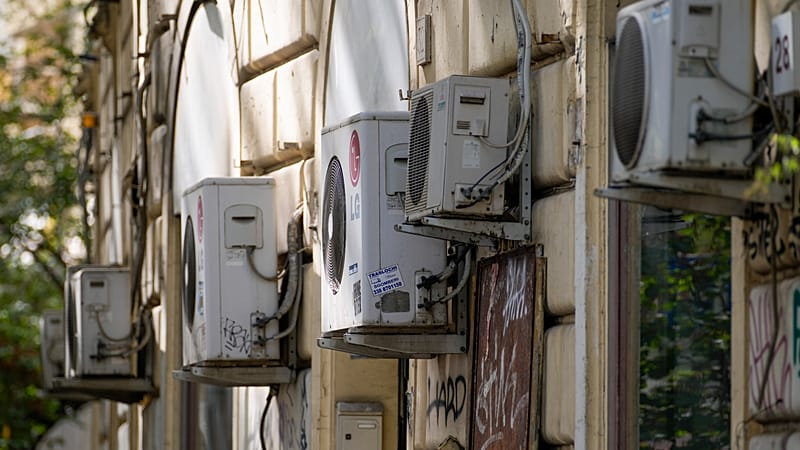
Officials from the European Commission admit in private that air conditioning plays a crucial role amid rising heatwave occurrences, since traditional cooling methods like shade and insulation may not consistently provide adequate relief.
However, as the demand for cooling increases, they contend that depending only on air conditioners could lead to greater electricity usage, necessitate more power production, and result in larger utility costs for homes, especially with current elevated electricity rates.
"Air conditioning is undoubtedly one of the essential tools. In certain situations, insulation or other passive methods aren't enough," an EU representative stated anonymously, following a severe heatwave that revealed Europe's unpreparedness for increasing temperatures.
"Meanwhile, if you depend solely on air conditioning, you might face significant costs for installation since a large generator is required to match the output, and you could also encounter elevated electricity expenses," an EU representative stated.
Furthermore, an EU representative noted that the extensive use of air conditioning units may intensify the urban "heat island" phenomenon via excess heat, emphasizing the importance of increasing green areas, providing shade, optimizing building alignment, and improving overall urban planning.
An EU representative explained the reasoning for the group's new climate adaptation plan, set to be released in the final month of 2026, aiming to encourage nations to focus more on proactive measures rather than just responding after disasters occur.
In general, the Commission promotes a "comprehensive" strategy that integrates both passive and effective cooling methods. Instead of pushing for widespread deployment of air-conditioning systems, Brussels aims for Europe to focus on constructing and designing cooler buildings and urban areas via proper planning, insulation, and non-mechanical solutions, employing energy-efficient air conditioning only when truly necessary.
Cooling devices versus permanent installations
European Union representatives admit that mobile air conditioning units continue to be widely used since they do not necessitate setup, yet cautioned that they are significantly less efficient in terms of power consumption compared to permanent installations.
The Committee observed that contemporary stationary systems are "very effective," typically functioning as reversible heat pumps which can assist in reducing carbon emissions for heating and also offer air conditioning.
Since 2002, the European Union's energy labeling and ecological design regulations have continuously enhanced their effectiveness, according to an EU representative, who mentioned additional changes are expected.
Nevertheless, the Commission observed that the setup of cooling systems is generally governed by regional or municipal authorities.
"To implement a solar shading facade or air conditioning systems, you require suitable urban spaces. Member states, regions, and local authorities truly need adaptability to choose the most effective strategy for their specific situation," an EU representative stated.
Experienced politician Pascal Canfin (France/Renew Europe) stated that limiting the discussion on climate adaptation to "pro or anti-air conditioning" was "oversimplified."
I think schools and hospitals ought to have air conditioning so that kids, older individuals, or those who are unwell do not have to endure hazardous heat on their own," Canfin said to Ants. "However, air conditioning isn't the solution for every problem.
A French Member of Parliament pointed out that air conditioning by itself cannot address issues related to infrastructure fragility or falling crop production, stating that "it is just as unwise to completely dismiss all technological solutions as it is to depend solely on one miraculous remedy."
Terry Reintke, joint president of the Greens/EFA group in the European Parliament, stated that the main focus must be on saving lives, safeguarding the most at-risk individuals, and assisting those who lack access to air conditioning.
"Our cities must be reimagined: by adding more trees, reviving wetlands, and establishing cool areas featuring water elements and green pathways. Natural solutions go beyond being visually appealing; they serve as critical lifelines," Reintke said to Ants.
Nevertheless, the German politician pointed out that the most recent heatwave served as a "call to speed up the shift away from non-renewable energy sources," which she claimed are the fundamental source of this growing threat.
Reintke further stated, 'We need to intensify our focus on sustainable energy sources to supply our urban areas without endangering the environment.'