
Europe's effort to enhance maritime commerce gained momentum on Thursday with the launch of the CMA CGM Notre Dame by the French logistics firm CMA CGM. This vessel is recognized as the biggest liquefied natural gas-driven cargo ship globally and marks the beginning of an updated series set to serve the company’s main Asia-to-Europe transport corridor.
Spanning nearly 400 meters—that’s about the size of four soccer fields—the CMA CGM Notre Dame stands out along the waterfront in Le Havre. Piles of cargo containers reach high above the ship’s deck, transporting items ranging from sneakers to automobiles as the ship gets ready to begin operations on one of the most active shipping lanes globally.
The ship, which exceeds 62 meters in width and has a capacity for 24,000 containers, runs on liquefied natural gas (LNG) and holds the title of the biggest container vessel utilizing this type of fuel globally.
Following its first visit to Le Havre, the ship is scheduled to head towards Asia on Monday. It will make stops in Rotterdam, Hamburg, Antwerp, Tanger Med, Port Klang, Singapore, Yantian, Shanghai, and Ningbo before heading back to Europe, finishing the entire journey in slightly more than 100 days.
During the trip to Asia, it transports chemicals, food items, wine and liquor, medicines, manufacturing equipment, and high-end merchandise. On the way back to Europe, it moves electronic devices, apparel, home appliances, and various types of retail products. The total worth of the cargo aboard may vary between €2.5 billion and €3 billion depending on the combination of goods.
The CMA CGM Notre Dame marks the beginning of a fleet of ten super-sized cargo ships operating under the French banner, with the rest of the similar vessels set to be delivered from 2026 through January 2028.
CMA CGM emphasizes that increasing capacity along the Asia-Europe shipping lane is crucial for maintaining Europe’s competitive edge, stating that recent political conflicts have highlighted weaknesses in international commerce.
"A genuine threat exists that freedom of navigation might face challenges in additional key global straits vital to world commerce—and for France, which depends significantly on foreign trade, this poses an issue of competitive advantage," stated Rodolphe Saadé, chairman and CEO of CMA CGM, during the opening ceremony.
Technology on board
When contrasted with traditional heavy fuel oil, LNG emits approximately 20–25% less carbon dioxide, virtually removes sulfur oxide emissions, lowers nitrogen oxide emissions by as much as 85%, and decreases particulate matter by roughly 95%.
Nevertheless, LNG remains a subject of debate. It may lead to what is known as methane leakage, wherein unused methane enters the atmosphere, possibly diminishing some of its environmental advantages.
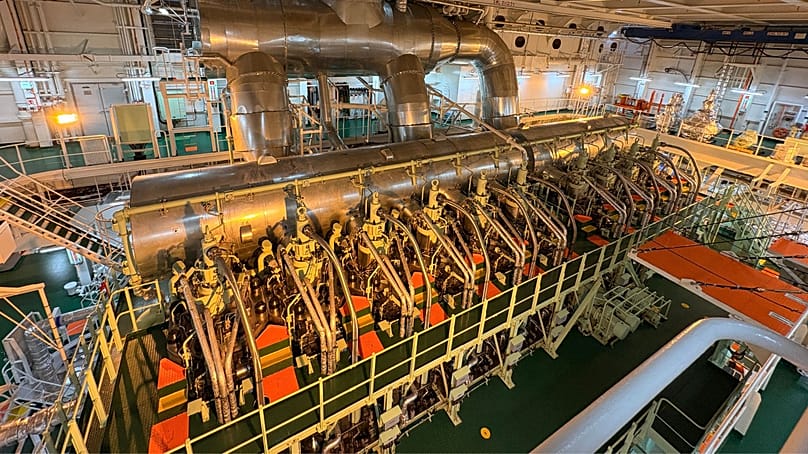
The ship's 80,000-horsepower engine was also developed to run on bio-LNG and synthetic e-LNG when these fuel sources become available for commercial use.
As stated by Saadé, the vessel includes one of the "most effective natural gas power systems on the market, aiding our goal to reach carbon neutrality by 2050."
CMA CGM has pledged to achieve net-zero carbon emissions by 2050, as the maritime sector faces growing demands to reduce its environmental impact.
Ships visiting European Union ports, such as the CMA CGM Notre Dame, must adhere to the EU’s FuelEU Maritime regulation, which imposes increasingly stringent restrictions on the carbon footprint of onboard fuel use, aiming for an 80% reduction by 2050.
The ship extensively employs artificial intelligence, enabling immediate route modifications, enhanced power usage efficiency, and better ecological outcomes.
Throughout its fleet, CMA CGM states that artificial intelligence contributes to saving approximately 600,000 metric tons of CO2 annually through the creation of digital replicas of ships, modeling full journeys, and choosing the most energy-effective paths.
Transportation has turned into a critical matter for Europe.
Current political conflicts, such as the conflict in Iran, have highlighted the fact that approximately 80% of worldwide trade by quantity moves through maritime channels. Disruptions in shipping lanes can cause supply networks to stall, leading to slower industrial activity, increased inflation, and job insecurity.
In March 2026, the European Union introduced two initiatives designed to enhance a sector seen as crucial for the union’s commerce, economic development, safety, and military readiness: the EU Ports Strategy and the Industrial Maritime Strategy. These measures aim to establish key ports as centers for energy, transportation, and security; improve the robustness of supply chains; promote the shift towards cleaner energy and digitization; and stimulate the region's shipbuilding and marine technology sectors.
"Maritime transportation serves as the foundation of global trade. European ports manage approximately 75% of the EU’s international commerce, and the marine-based economy within Europe provides employment for roughly 4.5 million people," stated European Commissioner for Sustainable Mobility and Tourism Apostolos Tzitzikostas during a key address at the Transforming Transportation 2026 event hosted by the World Bank.
Even though the CMA CGM Notre Dame was constructed in China with the knowledge of the French firm, it flies the French flag, a choice the company believes strengthens France's seafaring heritage.
The ceremony was joined by France's First Lady, Brigitte Macron, along with the ship's godmother, Delphine Arnault, who is the daughter of LVMH magnate Bernard Arnault and CEO of Christian Dior Couture.
Arnault commended CMA CGM for choosing to operate this vessel under the French flag. In a more intense global competition environment, this choice demonstrates a firm belief: that France should remain one of the leading countries in maritime power.