
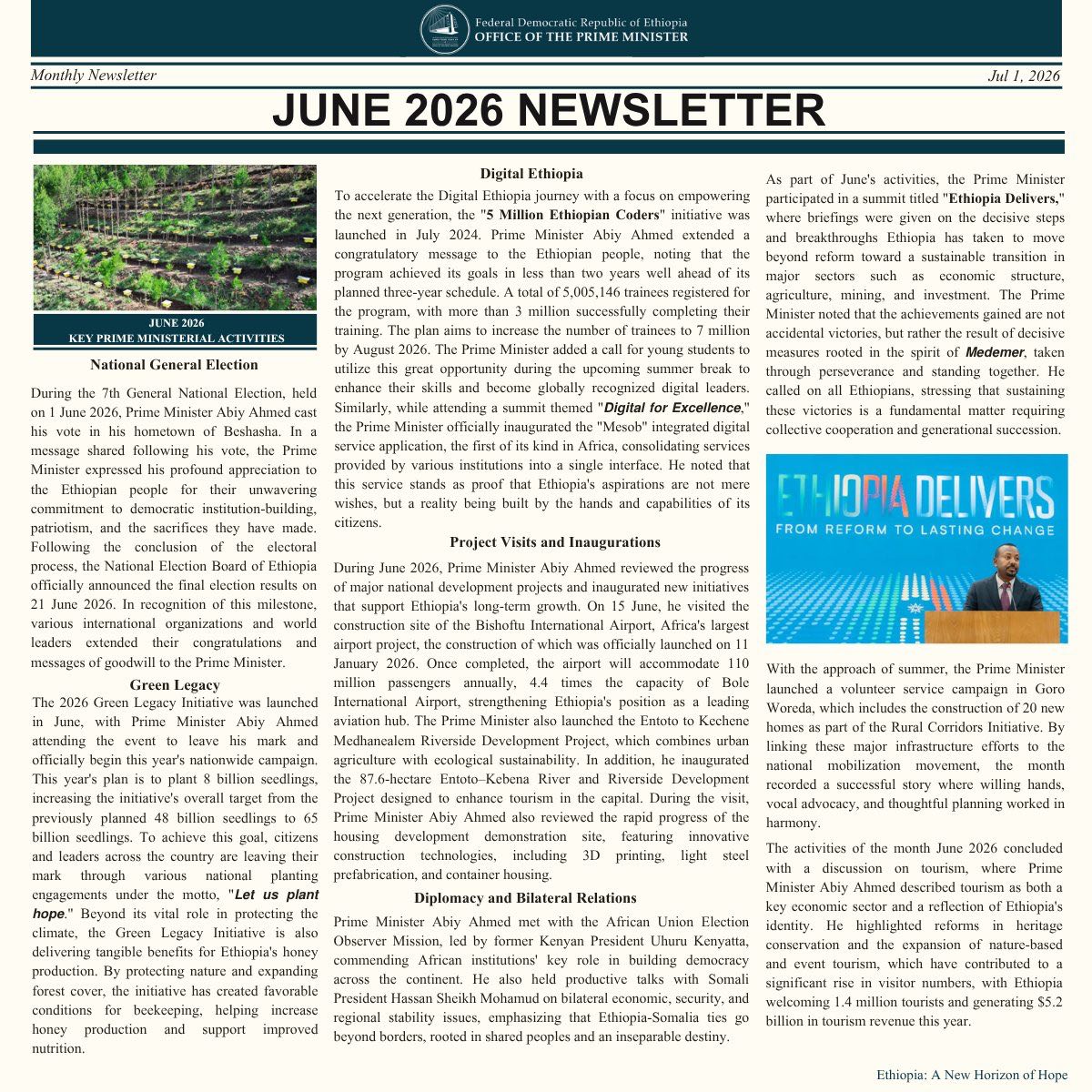
Addis Ababa, July 1, 2026 (ENA) — Over the last month, Ethiopia has achieved significant progress in democratic administration, technological advancement, and large-scale construction projects, indicating a move towards increased domestic efficiency and sustained economic expansion.
According to its monthly summary, the Office of the Prime Minister highlighted that Prime Minister Abiy Ahmed has led several significant projects reflecting the unified execution of Ethiopia's extended national development plan within various key areas.
A notable accomplishment this month was the completion of Ethiopia's 7th General National Election, as the National Election Board of Ethiopia formally declared the outcomes on 21 June 2026. Following his vote in Beshasha, Prime Minister Abiy praised residents for their calm involvement, national pride, and dedication to reinforcing democratic structures. The voting procedure garnered well-wishes from international bodies and world figures, acknowledging Ethiopia’s ongoing advancements in democracy.
Ethiopia achieved a significant step forward in its digital evolution. The administration's bold "5 Million Ethiopian Coders" program exceeded its initial objective before time, enrolling 5,005,146 individuals and producing over three million tech-savvy workers within just under two years. Encouraged by this achievement, the government now aims to recruit seven million Ethiopians by August 2026, reinforcing the nation's status as a rising center for technological advancement across Africa.
Alongside this accomplishment was the introduction of MESOB, Africa’s pioneering unified digital public service platform, consolidating offerings from various governmental bodies within one convenient app. This initiative represents an essential advancement in developing a contemporary, effective, and technologically linked administrative system.
Additional major infrastructure initiatives kept moving forward. The development of the Bishoftu International Airport progressed quickly, with the planned air transport center expected to handle 110 million travelers each year—increasing Ethiopia's airport capacity to about four and a half times that of Bole International Airport and strengthening the nation's status as one of Africa's top aviation entry points.
At the same time, Addis Ababa's plan for city renewal achieved a new success with the opening of the 87.6-acre Entoto–Kebena River and Riverside Development Project, as well as the introduction of the Entoto–Kechene Medhanealem Riverside Development Project. The capital city has also launched modern residential projects using 3D printing techniques and lightweight steel construction methods, showcasing Ethiopia’s increasing focus on eco-friendly, tech-based urban growth.
Another key focus of the nation was environmental protection. The government formally introduced the 2026 Green Legacy Project, raising the total national objective to 65 billion tree saplings. With the slogan, "Let Us Plant Hope," Ethiopia aims to cultivate eight billion saplings throughout this wet season, thereby enhancing forest area, rehabilitating damaged environments, boosting resistance against climate change, and improving life in rural communities, such as promoting higher beekeeping output.
Meanwhile, a countrywide summer volunteering initiative began in Goro Woreda, bringing together local residents to build 20 additional houses as part of the Rural Corridors Program, emphasizing the administration's ongoing commitment to equitable rural growth and public involvement.
In terms of diplomacy, Ethiopia strengthened regional collaboration via multiple top-tier interactions. Prime Minister Abiy engaged in fruitful talks with the African Union Electoral Observation Mission, headed by ex-Kenyan leader Uhuru Kenyatta, and had direct conversations with Somali President Hassan Sheikh Mohamud regarding enhancing regional stability, safety, economic partnership, and mutual development between the two adjacent countries.
The government's extensive progress was thoroughly examined at the "Ethiopia Delivers" conference, with representatives emphasizing the nation's continuous structural changes in farming, minerals, investments, manufacturing, and public administration aligned with the Medemer approach to growth.
The extensive changes are now leading to clear economic benefits. The tourism industry in Ethiopia received 1.4 million foreign tourists within the last year, earning an all-time high of $5.2 billion, highlighting the rising worldwide interest in the nation's developing tourist spots, abundant historical culture, and continuous development of top-tier facilities.
The office of the Prime Minister stated that the progress made during the last month demonstrates Ethiopia's ongoing dedication to strengthening democracy, promoting technology, achieving sustainability, and enhancing regional collaboration as the nation works toward its long-term objective of shared wealth and economic growth.