
In March 2028, Russian troops move into Narva, a modest Estonian town, and raise their banner. With acclaim for controlled areas from the conflict in Ukraine, Russia feels emboldened. The West’s shared defense system has collapsed, and as NATO—an aimless and disoriented entity—observes, the heads of state from Russia and China speak over a direct line and share contented comments.
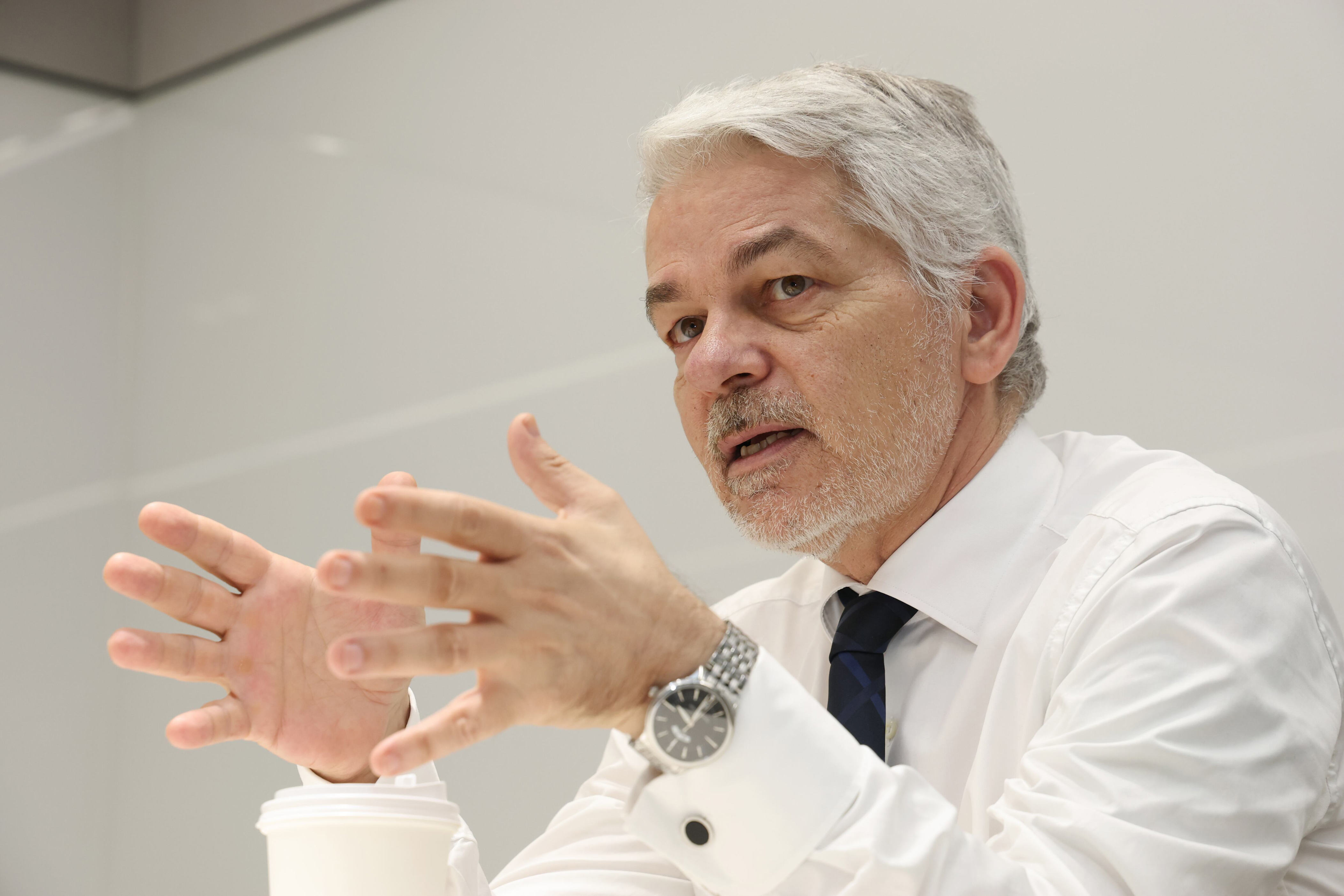
This situation was presented in the book *If Russia Wins*, released last year by Carlo Masala (58), who serves as a professor at the Bundeswehr University in Munich, Germany. Previously serving as the deputy director of the research department at the NATO Defense College, Masala has been leading the think tank Center for Information and Security Studies (CISS) at the Bundeswehr University since 2024. The visions he outlines about a world after the Ukraine conflict are not just imaginative ideas. In an interview with this newspaper on July 1st, prior to the launch of the Korean edition, Masala remarked, "Democratic nations around the globe are encountering significant resistance. Should China and Russia shape upcoming global standards, South Korea—which developed via open free trade—will be unable to avoid the consequences."
Masala stated, "This conflict will determine the future of global governance." When asked about his focus on both Russia and China, he explained, "If Ukraine suffers a loss, it could signal to China that powerful America and Europe do not have the determination or capacity to back Ukraine. This would make the idea more believable that the same situation might occur if China were to attack Taiwan or North Korea targeted South Korea."
When questioned whether the ongoing conflict might signal the start of another global war, he set clear boundaries, stating, "I think this is a future we will not witness," yet also noted, "Russia will not carry out an all-out assault against NATO members. Rather, it will challenge NATO by pushing for its collapse." He forecasts that Russia will raise its banners in locations such as Narva—territories symbolically within NATO but lacking significant strategic importance—in order to assess the unity of the alliance by causing hesitation in invoking collective defense measures.
Masala further emphasized, "We need to shift our perception of the world through a security lens." He elaborated, "South Korea concentrates on regional conflicts such as with China, North Korea, and Europe focuses on areas like the Arctic and Eastern Europe, whereas nations like Russia and China perceive the globe as one integrated battlefield, seeking to redirect Western focus and capitalize on chances." On the latest tensions between Iran and the United States, he remarked, "I regard it as an attempt to distract attention. For Russia and China, the U.S. allocating substantial resources to the Middle East represented a prime opening."
Masala described his initial link with South Korea: "When I was young, I studied taekwondo under 'Kim Sabu,' who traveled to Germany to spread this martial art." Since the 1990s, he has made between five to six visits to South Korea, including invitations from the Ministry of Unification. "As an academic, it was intriguing to see how terminology employed by the South Korean government gradually evolved concerning unification," he mentioned. Additionally, he noted, "The South Korean defense sector holds considerable influence in Europe, and the nation isn’t detached from conflict. Should Ukraine suffer defeat, South Korea would be affected as well."