
Although discussions about 'Honam semiconductor investments' have captured interest, Gangwon Province is steadily advancing significant business investments.
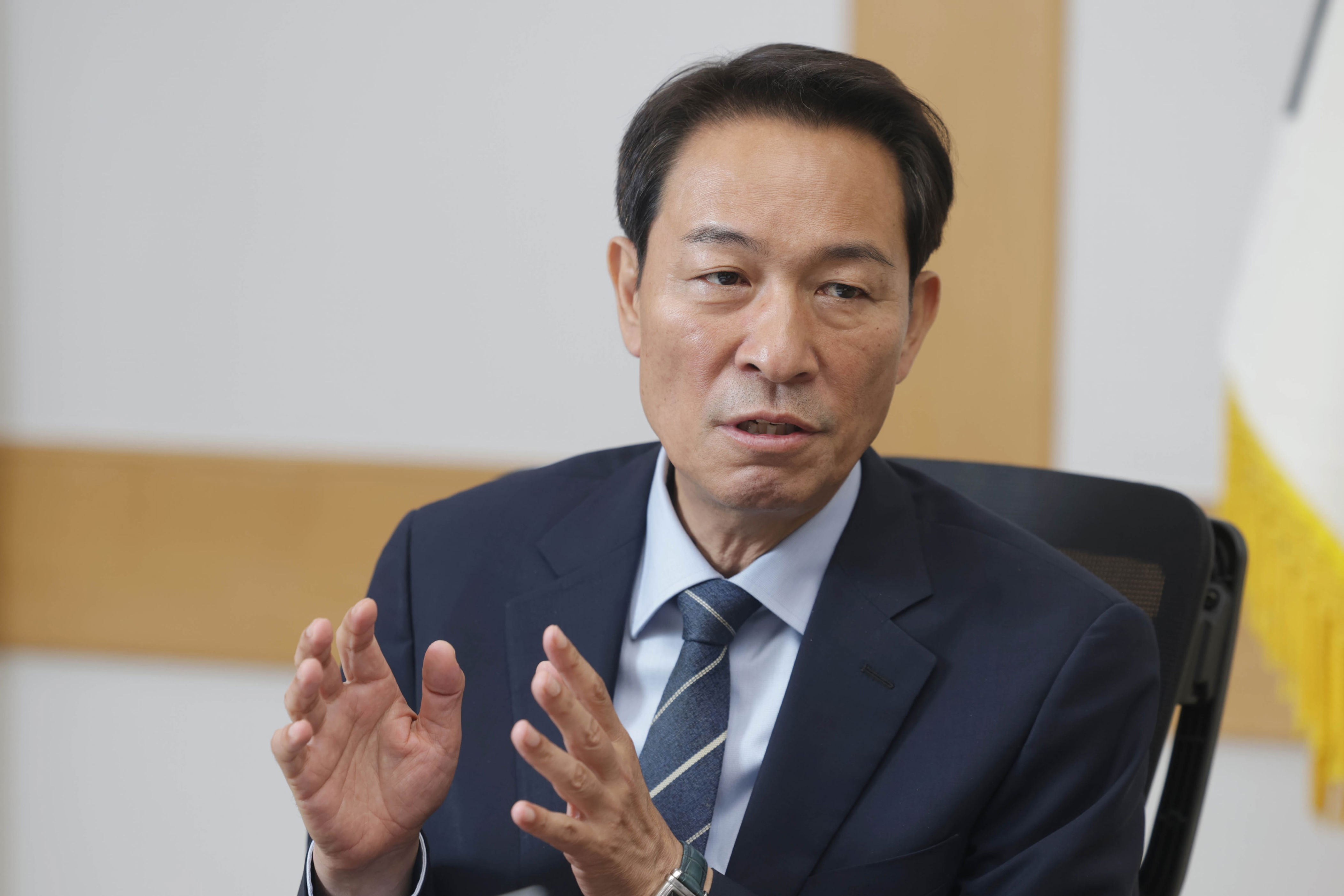
Woo Sang-ho, 64, the head of Gangwon Province, mentioned during an interview with this newspaper on June 30 at the Gangwon Provincial Government Building in Chuncheon, "The GS Group intends to develop a 2.4GW-level artificial intelligence data center in Donghae, Gangwon, while SK Group seeks to establish a 1GW-level AI data center within the Gangwon area. This marks the initial instance where two leading Korean corporations have jointly invested in Gangwon." The inaugural approval granted by Governor Woo, who assumed his position on July 1, concerned the establishment of an 'AI Data Center Development Task Force.'
Governor Woo highlighted the importance of drawing large businesses during his campaign for the upcoming local elections on June 3. He stated, "The Lee Jae Myung administration launched an extensive 'industrial renewal' strategy beginning in January this year. AI data centers play a central role in this initiative." Governor Woo further mentioned, "During the 'National Conference on the Three Major Initiatives for South Korea's Significant Advancement,' held on June 29, discussions mainly focused on Honam; however, proposals from GS Group and SK Group to construct AI data centers in Gangwon were also present. The company names weren't revealed as requested by them."
**-What makes Gangwon Province interested in drawing in AI data centers?**
Artificial intelligence data centers are 'energy-demanding sectors' that use tenfold more electricity compared to regular data centers. This renders their construction nearly unfeasible within the capital area. Gangwon Province offers ample energy supply along with a sparse population and fewer regulatory constraints.
**-What transformations will the AI data centers introduce?**
GS is anticipated to allocate between 30 trillion and 120 trillion South Korean won into Gangwon, with SK expecting an investment ranging from 20 trillion to 70 trillion South Korean won. This encompasses the scope of adjacent industrial zones and related sectors. It represents the biggest financial commitment ever seen in Gangwon. With the provincial government's yearly budget amounting to 9 trillion South Korean won, this funding equates to what would be spent over several decades. Constructing a data center capable of handling 1 gigawatt usually demands approximately 20,000 laborers throughout the building phase. Once completed, about 3,000 staff members will be employed at the site.
**-What functions will the AI data centers fulfill?**
The AI data centers that GS and SK intend to construct are intended for international purposes rather than local consumption. These facilities will manage significant amounts of data for multinational technology corporations. While many associate Gangwon with potatoes and cabbage, our objective is to have people connect it with major tech firms such as Google and Meta.
**- SK has not yet revealed a particular venue. How is things progressing?**
A substation of 345kV level is necessary for establishing a 1GW artificial intelligence data center. We are currently engaging with the Korea Electric Power Corporation to obtain scheduling for the construction of the substation. A dedicated team has been established for this purpose. The investment strategy remains unchanged. We maintain good coordination with SK and have inspected possible locations such as Okgye and Gangneung. We will assist in facilitating an early start of construction.
**-How is the semiconductor manufacturing plant initiative being handled under the prior administration?**
Following talks with Samsung, we have determined that establishing a semiconductor manufacturing plant (fab) in Wonju is not practical at this time. Instead, we will make use of the current Korea Semiconductor Academy and semiconductor materials testing center to develop expertise within the industry. I think Gangwon's advantages are found in renewable energy, AI data centers, and aerospace fields such as drones. Our aim is to draw businesses focused on these areas.
**- You promised to establish a 'Clean Energy Corridor in the Border Area.' Could you explain what this involves?**
This commitment seeks to transform the challenges faced by Gangwon's border areas—including Cheorwon, Hwacheon, Yanggu, Inje, and Goseong—into new possibilities. Recently, the Ministry of National Defense revealed intentions to shift the Civilian Control Line (CCL) northward by approximately 2 kilometers and remove military restricted zones covering an area 150 times larger than Yeouido in Seoul. We plan to develop renewable energy facilities such as solar and wind farms on the previously unused land now made accessible. The electricity produced will be provided to local residents, with excess power being sold to generate revenue for the community.
**-What are your intentions regarding the upcoming Gangwon Provincial Government Building project?**
Building the new office will cost 500 billion South Korean won. Gangwon does not currently possess such a large amount of funds. It makes sense to boost tax income by drawing in businesses and implement strategies to rejuvenate the older city center prior to moving forward.
**-In the June 3 local elections, you stated, 'I was dispatched by the president.'**
Recently, Hwacheon County has been chosen as a location for the 'rural basic income' initiative. This came about due to discussions with Cheong Wa Dae and the administration during my campaign. Going ahead, I plan to maintain collaboration with Cheong Wa Dae and the government to address Gangwon's challenges sequentially.
**-What type of leader would you like to become?**
I have never offered impossible guarantees or uttered hollow statements. For the coming four years, I will not expose the citizens to 'deceptive optimism.'