
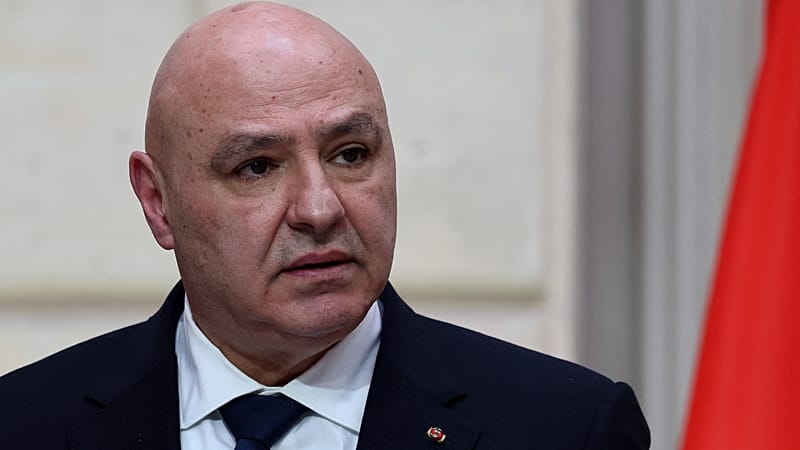
Lebanon's president, Joseph Aoun, claimed that Iran is treating Lebanon as leverage in its conflict with the U.S. and Israel. Meanwhile, Tehran denied these claims via its foreign minister, stating that if Lebanon was truly a pawn in Iran's control, an arrangement would have been finalized long before now.
During an interview with the American television channel CNN, Aoun spoke about Iran's Islamic Revolution Guards Corps, stating: "This is not your country, it is ours."
He stated, "You aren't making an effort to assist us. The Lebanese are bearing the cost of your personal goals, and our priorities differ from yours."
Aoun emphasized his dedication to taking all necessary measures to stop Lebanon from experiencing more intense conflict, stating that the citizens of Lebanon have had enough of the ongoing battles between Israel and Hezbollah, an organization supported by Iran and holds significant power within the nation.
"Our bodies are exhausted, and we desire to live in tranquility," he stated, emphasizing that the people of Lebanon merit a life filled with respect and should not have their residences reduced to rubble once every five or ten years.
Lebanon's president stated that his nation is prepared for direct talks with Israel aimed at achieving a truce, adding: "We are ready, eager, and dedicated to engage in discussions. There exists a significant chance to put an end to the conflict between Lebanon and Israel," highlighting that both parties have grown weary of warfare since 1948.
Aoun mentioned that he detected a significant yearning for peace across all segments of Lebanese society, including the Shiite population, with some expressing their exhaustion from ongoing conflicts. Speaking firmly, he stated, "They are citizens of Lebanon, not adherents of Naim Qassem."
Nevertheless, the President of Lebanon condemned Israel's military approach towards Hezbollah, stating that the group's power can solely be eradicated by the government following an Israeli retreat, and emphasizing that dialogue remains the sole resolution. "They may enter the country or obliterate it entirely, yet they won't attain their goal, as Hezbollah represents an ideology."
Prior to becoming president, Aoun held the position of army chief for eight years. During this time, he sustained injuries in combat, with fragments remaining inside his body, and experienced lasting hearing loss due to proximity to active warfare zones. Despite this, he emphasized his opposition to conflict and support for peaceful resolutions, stating: "I favor dialogue over war. I do not wish my children or the citizens of Lebanon to endure similar hardships."
Aoun ended his statement by expressing his intention to engage in discussions and convince Hezbollah to disband, acknowledging that this outcome is achievable eventually, although it comes with significant consequences.
The stance taken by the Lebanese presidential office corresponds to previous remarks made by Prime Minister Nawaf Salam, who similarly called on Tehran to cease utilizing Beirut as a means of coercion.
Araqchi tells Aoun: "Protect Lebanon from its actual adversary"
In response to Aoun's statements, Iranian Foreign Minister Abbas Araqchi dismissed the allegations made by the Lebanese president regarding Iran's involvement in matters within Beirut.
On a social media post, Araqchi stated: "According to Mr. Aoun's statements, someone could get the impression that Iran occupies 20% of Lebanon, has forced 25% of its people to leave their homes, and bomb the nation every day," he added, saying, "If Lebanon was something Iran could use as leverage, we would have come to an arrangement much earlier."
He stated: "Protect Lebanon from your true adversary, Mr. President."
Israeli attack results in death of Lebanese military personnel Bombing incident leads to fatalities among Lebanese forces Attack carried out by Israeli entities causes loss of life within Lebanese army Casualties reported as Israeli operation targets Lebanese troops Lebanese soldiers killed in Israeli aerial assault
As the Lebanese president shows willingness to engage in talks with Tel Aviv to conclude the conflict, attempts to reduce tensions faced a challenge on the ground, following an Israeli airstrike that hit a Lebanese military vehicle along the Khardali-Nabatieh route, resulting in the deaths of multiple soldiers, including two officers.
The Israeli military targeted a vehicle in the village of Jarmak located in the southern part of the nation.
The southern suburbs of Beirut compared to northern Israel
Israel has mentioned a new strategy where the southern suburbs of Beirut might be attacked if northern regions face an assault from Hezbollah, leading Iranian Foreign Minister Abbas Araqchi to caution that striking the Lebanese capital could lead to another conflict in the Middle East.
Hezbollah opposes any conversation about disarming until Israel pulls out. Its leader, Naim Qassem, views talks as equivalent to capitulation, maintaining that this perspective is not supported by significant parts of the Lebanese population.
Ever since its founding in the 1980s, Hezbollah has engaged in multiple conflicts with Israel, resulting in Israel's departure from the border area it had controlled since 1978.
This year, the group launched missiles toward Israel following a combined U.S.-Israeli strike on Iran that led to the death of Supreme Leader Ali Khamenei and several high-ranking military officials.
Two days prior, Lebanon and Israel finalized a deal to start enforcing a cease-fire, which involves establishing trial areas managed by the Lebanese military, with peace dependent on a full stoppage of Hezbollah's assaults, along with the removal of all their combatants from the region below the Litani River.
As per official data from Lebanon, Israeli armed actions have resulted in the death of over 3,516 individuals and injured more than 10,670 others. Additionally, they have forced more than one million residents to leave their homes since late February—the time when Iran’s Supreme Leader Ali Khamenei was assassinated, prompting Hezbollah to become involved in the conflict among Tehran, Washington, and Tel Aviv.
As per the World Health Organization, over 600 individuals have lost their lives due to military activities in Lebanon since April 17th.